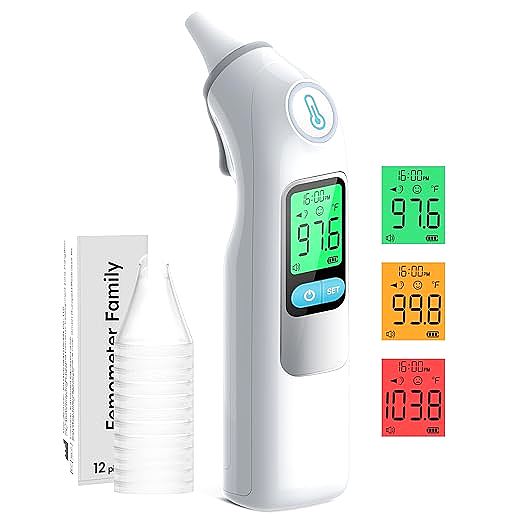
Beyond the Beep: A Parent’s Guide to the Science of Ear Thermometers

It’s 3 a.m. The house is silent, save for the soft hum of the refrigerator. But in your child’s room, a different kind of quiet hangs in the air—the heavy silence of worry. You’ve been woken by a faint cough, and a hand to their forehead confirms your fear: they feel warm. Too warm. In this moment, the world shrinks to a single, urgent question: “How high is the fever?” What follows is often a fumbling, fraught search for a thermometer, a clumsy attempt to get a reading from a sleepy, irritable child, and the lingering, anxious doubt: “Is this number even right?”
This scenario is a rite of passage for nearly every parent. But what if that moment could be transformed from one of anxiety into one of quiet confidence? The modern digital ear thermometer, when understood and used correctly, is more than just a piece of plastic and circuitry. It is an instrument of clarity, a source of quick, reliable information that empowers you to make calm, informed decisions. To truly trust what it tells you, however, you must first understand how it works. This is not a product review; it’s a deep dive into the science behind the beep, using the Femometer Family DET-1015 as our case study to explore how thoughtful engineering can bring serenity to the stressful task of monitoring your family’s health.

Deconstructing the Doubts: Why Ear Thermometers Can Be Remarkably Accurate
One of the most persistent myths in home healthcare is that ear thermometers are inherently inaccurate. This belief often stems from frustrating experiences with improper use, leading many to dismiss a genuinely powerful technology. The truth is, the ear canal is a superb location for measuring temperature, provided you know the science.
The secret lies with the eardrum, or more formally, the tympanic membrane. This tiny, delicate structure shares the same blood supply as the hypothalamus, the brain’s temperature control center. This anatomical fact is crucial—it means the heat radiating from the eardrum is a nearly perfect reflection of the body’s core temperature. An ear thermometer doesn’t measure the temperature of the ear canal skin; it uses a sophisticated infrared (IR) sensor to measure the invisible heat energy radiating directly from the tympanic membrane. Think of it as a thermal camera that can precisely see the body’s true heat signature, a principle so reliable that these devices must often meet standards like ASTM E1965-98 to ensure their clinical-grade accuracy.
But what about a cold room or a sweaty brow? This is where the “smart” factor comes in. A well-designed thermometer like the Femometer DET-1015 incorporates a built-in System on a Chip (SOC) that runs a temperature compensation algorithm. It subtly measures the ambient temperature and adjusts the final reading to account for environmental influence, ensuring the number on the screen is a true representation of the core temperature, not the room’s. The accuracy isn’t magic; it’s a careful orchestration of physics, anatomy, and intelligent software.

A Case Study in Thoughtful Design: The Femometer Family DET-1015
So, if the science is sound, how do these principles translate into a real-world device designed for that frantic parent at midnight? Let’s take a closer look at the Femometer Family DET-1015, not as a product to be sold, but as a case study in how thoughtful engineering can directly address parental anxiety.
The first challenge in our 3 a.m. scenario is the need for speed and clarity. A squirming child has no patience for a thermometer that takes minutes to work. The DET-1015 delivers a reading in a single second. This speed is more than a convenience; it’s a feature that respects the reality of caring for a sick child. This instant feedback is paired with a large, backlit screen that uses a three-color alert system: green for normal, orange for a low-grade fever, and red for a high fever. This is a silent language of urgency. In a dark room, bleary-eyed and without your reading glasses, you get an immediate, intuitive understanding of the situation. For a sleeping baby, this is a godsend. The ability to switch to a silent mode means you can monitor their temperature throughout the night without a single disruptive beep, preserving their much-needed rest.
Hygiene is another paramount concern, especially when illness is spreading through a household. The DET-1015 addresses this with an intelligently engineered, non-contact system. The thermometer is designed to require one of its 24 included disposable probe covers for every use. A small sensor at the base of the probe detects the presence of a cover; without one, the screen displays “CAP” and refuses to take a reading. This isn’t an annoyance; it’s a critical safety feature, a “poka-yoke” or mistake-proofing design that makes hygienic practice automatic. Furthermore, a small trigger button allows for a touch-free ejection of the used cover. As one user amusingly noted, “it ejected it almost half way across the room.” This small detail reinforces a sterile process, minimizing the risk of cross-contamination between family members.
Your Step-by-Step Ritual for a Perfect Temperature Reading
But even the most sophisticated instrument is only as good as its operator. Owning a device like the DET-1015 is half the battle; the other half is mastering its use. Let’s move from the ‘what’ to the ‘how’ and walk through the simple ritual that unlocks its full accuracy.
Step 1: The Pre-Flight Check
Before you even approach your child, ensure three things: the thermometer’s probe is clean, a fresh disposable cover is snapped securely in place (you’ll feel a slight click), and the battery is healthy. Low battery levels can sometimes compromise the accuracy of electronic devices.
Step 2: The Critical Maneuver
The ear canal is not a straight tube; it has a slight curve. To get a clear line of sight to the eardrum, you must gently straighten it. This is the single most important step for accuracy, and it varies by age:
| Age Group | Technique |
|---|---|
| Infants under 1 year | Gently pull the ear straight back. |
| Children over 1 year & Adults | Gently pull the ear up and back. |
This simple action aligns the canal so the infrared sensor can capture a true reading from the tympanic membrane, not the cooler wall of the ear canal.
Step 3: The Measurement & Reading
With the ear gently held in position, insert the probe snugly into the ear canal, ensuring it seals the opening. Press the measurement button. Within a second, the device will beep (if not in silent mode) and the screen will illuminate with the temperature and the corresponding color.
Common Pitfalls to Avoid:
* Excessive Earwax: A significant buildup of cerumen (earwax) can physically block the sensor’s view of the eardrum, leading to an artificially low reading.
* The “Warm Pillow” Effect: Avoid measuring an ear that your child has been lying on. The trapped heat will cause a falsely high reading. Wait 15-20 minutes or measure the other ear.
* Incorrect Angle: Don’t aim the probe towards the canal wall. Ensure it’s pointing towards the inside of the head, in the general direction of the opposite eye.
Understanding the Boundaries: Context is Everything
Now that you’re equipped with the technique to get a reliable reading, it’s equally important to understand what that reading means and when another method might be more appropriate. A powerful tool becomes even more valuable when you know its precise applications and limitations.
For newborns under 3 months, most pediatricians, including the American Academy of Pediatrics, still consider a rectal temperature to be the gold standard. A newborn’s ear canals are incredibly tiny and curved, making it more challenging to get a perfect reading. For this fragile age group, the undisputed accuracy of a rectal measurement is paramount.
For children over 3 months and adults, the ear thermometer is an excellent, reliable tool for screening and monitoring. The key is consistency. Always try to use the same ear and pay more attention to the trend of the temperature over time rather than obsessing over a single decimal point. A temperature that is steadily climbing is more concerning than one that is stable, even if it’s slightly elevated.

More Than Just a Number: The Full Feature Set
Modern thermometers also offer tools to help you track this trend. The DET-1015, for example, has a memory function that stores the last 30 readings. This feature transforms the device from a simple measurement tool into a health diary. When you call your doctor, you can report not just the current temperature, but its progression over the last 12 hours—”It was 100.4°F after breakfast, rose to 101.5°F by lunch, and is now 102.2°F”—which is far more useful clinical information. The use of standard AA batteries is also a thoughtful touch, sparing parents a frantic hunt for obscure button-cell batteries in the middle of the night.
Conclusion: From Anxiety to Empowerment
Returning to that dark, quiet room at 3 a.m., imagine a new scenario. You feel the warmth of your child’s forehead, but instead of panic, you feel prepared. You reach for a tool you understand and trust. You perform the simple, practiced ritual. In one silent second, a soft green or orange glow gives you the information you need. There is no guesswork, only data.
The journey from anxiety to empowerment in home healthcare is paved with knowledge. Understanding that the accuracy of a device like the Femometer DET-1015 is a partnership—a collaboration between its thoughtful, science-based design and your own informed technique—is the key. It allows you to replace doubt with data, and fear with the calm, confident competence of a prepared caregiver.