The Anatomy of a 10-Second Thermometer: Understanding Speed, Accuracy, and the Physics of Fever

You’ve been there. Feeling a little off, you reach for your digital thermometer. You place it under your tongue, wait for the beep, and see “98.9°F”. Just to be sure, you take it again a minute later. “98.2°F”. You try a third time. “99.1°F”. A wave of frustration washes over you. Is the thermometer broken? Are you getting sicker by the second? Or is the entire endeavor of at-home temperature reading a futile game of chance?
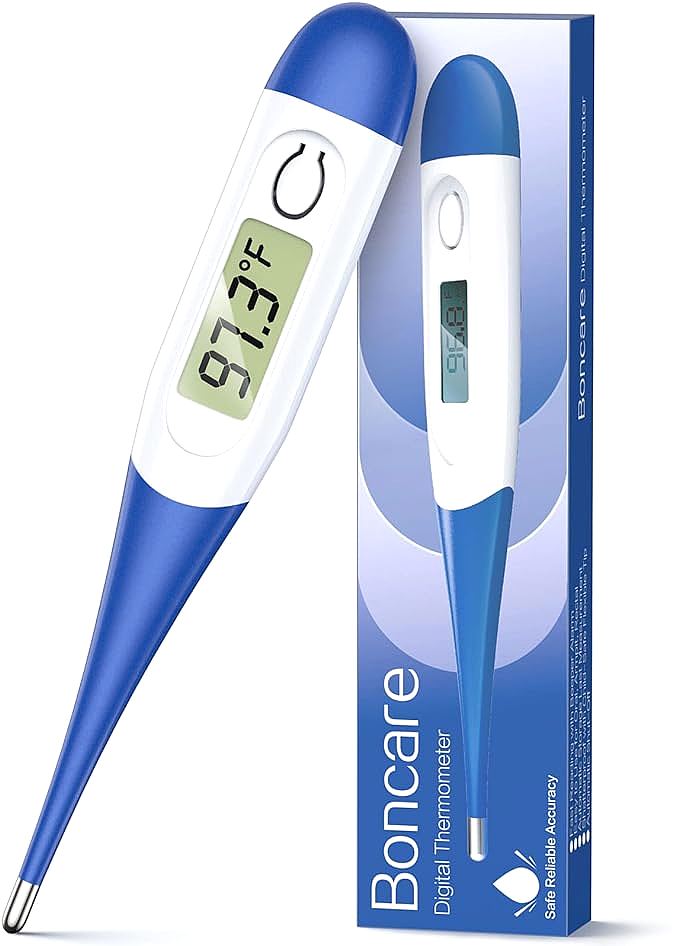
This experience, common with many affordable and fast digital thermometers like the popular Boncare GF-MT501, isn’t necessarily a sign of a faulty device. Instead, it’s a symptom of a fundamental misunderstanding of what these devices are actually doing. The problem isn’t just with the thermometer; it’s with our expectation that we can have a perfect, instant measurement of a complex biological parameter. To truly understand your thermometer and trust its readings, we need to dissect it—not with a screwdriver, but with a little bit of physics and engineering. This journey will reveal that the 10-second reading you crave is less a precise measurement and more of an incredibly sophisticated, high-speed prediction.
The Allure of Instant Answers: Speed vs. Certainty
Before we delve into the technology, let’s examine the psychology. When you or a loved one feels unwell, your mind craves certainty and it craves it now. The anxiety of a potential fever creates a powerful demand for a quick, definitive answer. The market has responded with devices that promise results in 15, 10, or even 8 seconds. This focus on speed, however, obscures a crucial trade-off in the world of measurement: the battle between speed and certainty.
In physics, accurately measuring temperature is about reaching a state of “thermal equilibrium.” This means the sensor of the thermometer and the tissue it’s measuring have to become the exact same temperature. Think of it like dropping a cold spoon into a cup of hot coffee. The spoon doesn’t instantly become the temperature of the coffee; it takes time for the heat to transfer and for the two to equalize. Your body and a thermometer are no different. This process, depending on the method, can take several minutes. So, how can a device possibly give you a reliable reading in just 10 seconds? The answer lies in a clever, and sometimes fallible, shortcut.
Inside the Tip: A Tiny Sensor’s Race Against Time
At the heart of your digital thermometer is a tiny electronic component called a thermistor. It’s a special type of resistor whose electrical resistance changes predictably with temperature. The thermometer’s microprocessor sends a tiny current through the thermistor and measures the resistance, which it then translates into the temperature reading you see on the screen.
The key challenge is that this process is not instantaneous. When you place the cool metal and silicone tip of the thermometer under your tongue, a race begins. Heat from the rich blood supply in the “sublingual pocket” (the area under your tongue) starts flowing into the probe. The thermistor’s resistance begins to change rapidly at first, and then more and more slowly as it gets closer to your body’s actual temperature. To get a true measurement, you’d have to wait until the heat transfer stops completely—until thermal equilibrium is achieved. This is known as the “direct mode” of measurement, and it can take a few minutes. But in our fast-paced world, few have the patience for that.
The 10-Second Prediction: The Truth About Predictive Algorithms
This is where the engineering magic—and the source of your frustration—comes in. Instead of waiting for the thermal race to finish, a 10-second thermometer acts like an experienced forecaster. It watches the first few seconds of the race, analyzes the rate at which the temperature is climbing (the “slope” of the temperature curve), and then uses a pre-programmed algorithm to predict the final temperature. It’s not measuring where the runner is, but rather calculating where the runner will be at the finish line. Think of it like an expert chef who can tell how done a steak is by the sizzle and smell, long before cutting into it.
This predictive model is what allows a device like the Boncare GF-MT501 to beep in about 10 seconds. It’s a remarkable piece of engineering that provides immense convenience. However, this prediction is highly sensitive to the initial conditions. If your mouth was slightly open, if you just had a sip of cool water, or if the thermometer tip is placed in a slightly different spot than before, the initial rate of temperature change will be different. A different starting curve leads the algorithm to a different predicted outcome. This is why back-to-back readings can vary by several tenths of a degree. The thermometer isn’t broken; its prediction engine is simply being fed slightly different data each time.
What ‘Clinically Accurate’ Actually Means (Hint: It’s Not Perfect)
“But the box says it’s clinically accurate!” you might protest. This is another widely misunderstood term. For a digital thermometer to be sold in the United States, for instance, it must meet standards set by organizations like ASTM International. The relevant standard, ASTM E1112, specifies the permissible error for electronic thermometers. For example, in the range of 98.6°F to 102.2°F (37.0°C to 39.0°C), the allowable laboratory error is typically ±0.2°F (±0.1°C).
This means a thermometer reading 99.0°F when your true temperature is 99.2°F is still considered perfectly accurate by industry standards. Add this allowable hardware variance to the inconsistencies introduced by the predictive algorithm and user technique, and you can begin to see why chasing a single, perfect number is a fool’s errand. Certifications like ISO 13485 are also important, but they refer to the quality management system of the manufacturer, ensuring consistent production processes, not the infallible accuracy of every single reading.
Conclusion: From Frustration to Finesse
The fluctuating readings from your 10-second thermometer are not a sign of failure, but a window into its very nature. It’s a device designed for convenience, trading minutes of waiting time for a sophisticated, but sensitive, prediction.
So, do you need to throw out your affordable thermometer and buy a hospital-grade device? Absolutely not. You simply need to shift your mindset from being a passive user to an informed operator. To tame the algorithm and get the most consistent readings possible, you can:
- Rest First: Sit calmly with your mouth closed for at least five minutes before taking an oral temperature to allow the tissue to stabilize. Avoid eating or drinking anything hot or cold for at least 15 minutes prior.
- Be Consistent: Aim for the same spot every time. For oral readings, place the tip deep into the sublingual pocket—the little hollows to the far left or right under your tongue. This area is rich in blood vessels and provides a more stable reading.
- Trust, But Verify: If a reading seems off, wait a minute and take it again, focusing on perfect technique. If you’re very concerned, you can ignore the first beep and leave the thermometer in for a full minute or two. Many will continue to slowly creep up to a more stable, direct-mode reading.
- Look for Trends, Not Absolutes: The most valuable information is not a single, isolated reading, but the trend over several hours or days. Is the temperature generally rising, falling, or stable? A consistent reading of 101.5°F is far more informative than readings that jump between 99.9°F and 100.5°F.
By understanding the physics in its tip and the algorithm in its brain, you transform a frustrating gadget into a useful tool. You learn to work with its limitations to get the information you truly need. The goal isn’t to find a perfect thermometer, but to become a smarter user, capable of turning a 10-second prediction into a confident health decision.