Beyond the Spec Sheet: A Deep Dive into Thermal Camera Specifications

Thermal imaging, a technology once confined to the domains of military operations and high-end industrial science, is undergoing a profound democratization. What required a five-figure budget and specialized training a decade ago is now accessible in the form of robust, handheld instruments for technicians, inspectors, and engineers. This shift has flooded the market with options, all brandishing impressive numbers on their spec sheets. But what do these numbers truly mean in the field?
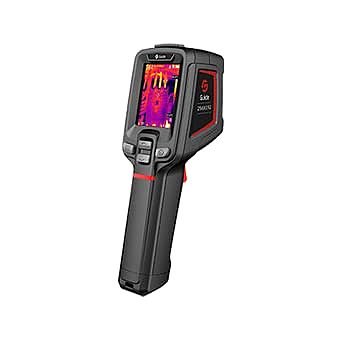
This is not a review. Instead, we will use a compelling example of this new breed of tool—the Guide Sensmart PC210—as our subject for dissection. We will peel back the layers of its specifications to understand the core principles and critical trade-offs that define a modern, entry-level professional thermal camera. By the end of this deep dive, you will be equipped to look past marketing hype and evaluate any thermal imager like an expert, understanding not just what it can do, but how and why it does it.
The Core Trinity: Resolution, Sensitivity, and the Sensor
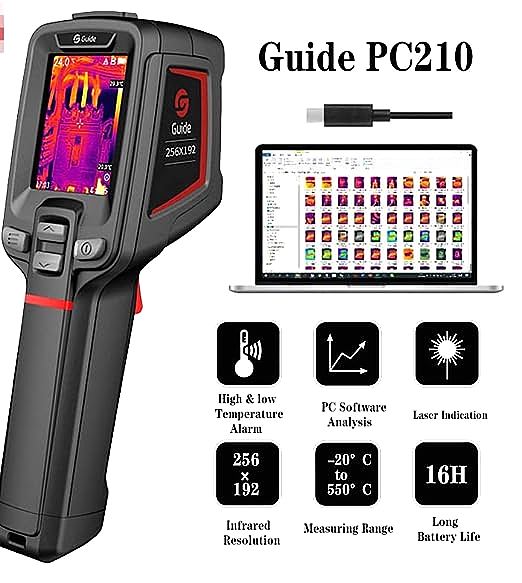
At the heart of any thermal camera lies a trinity of components that dictates its fundamental performance. It begins with the sensor, the engine that translates invisible infrared radiation into a visible picture. The PC210 employs a Vanadium Oxide (VOx) uncooled microbolometer. In simple terms, VOx sensors are the modern standard for professional imaging instruments, prized for their high stability across varying ambient temperatures and lower thermal noise. This translates directly into a more consistent and clearer image compared to older technologies like amorphous silicon (a-Si), much like a modern fuel-injected engine provides more reliable performance than an old carburetor.
With a capable engine in place, we look at its output. The first number that often grabs attention is spatial resolution. The PC210 features a 256×192 detector, which means it captures an array of 49,152 individual temperature measurement points in every single frame. This isn’t just about creating a prettier picture; it’s about diagnostic confidence. Imagine inspecting a large electrical panel from a safe distance. A low-resolution imager might blur several components together, showing a general warm area. With 49,152 pixels, however, you have a much higher probability of isolating the single, overheating lug nut or faulty breaker. This resolution marks a significant threshold where the tool moves from a general-purpose spot-checking device to a serious diagnostic instrument.
The third, and arguably most critical, element of the trinity is thermal sensitivity, or Noise Equivalent Temperature Difference (NETD). If resolution is what you can see, NETD is how well you can see it. It measures the smallest temperature difference the camera can detect. The PC210 is rated at 45 millikelvins (mK), or 0.045°C. To put this in perspective, think of it as the camera’s hearing. A high NETD camera is like trying to hear a whisper in a noisy room; a low NETD camera is like being in a soundproof booth. A sensitivity of 45 mK is firmly in professional territory (where anything below 50mK is considered excellent), and it is absolutely critical for applications where temperature differences are subtle, such as detecting the faint evaporative cooling effect of hidden moisture behind a wall or identifying early-stage bearing failure in a motor.
From Raw Data to Insightful Images: Processing and Control
But having a powerful sensor is only half the battle. A Formula 1 engine is useless without a skilled driver and a sophisticated control system. Similarly, the raw data from the sensor must be processed and controlled to become actionable insight. This is where features like manual level and span come into play.
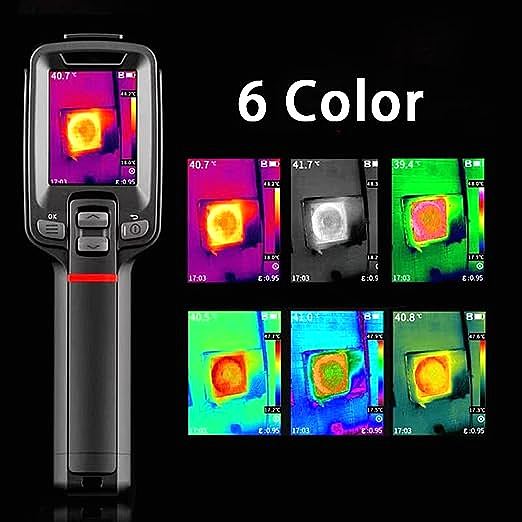
Most entry-level cameras operate in “Auto” mode, where the camera constantly adjusts the temperature scale to fit the hottest and coldest spots in the scene. While convenient, this can be misleading. Imagine looking at a hot steam pipe in the same view as a wall you’re checking for faulty insulation. The camera, dominated by the extreme heat of the pipe, will compress the temperature scale, making the subtle heat variations on the wall invisible. The PC210, however, includes full manual level and span control. This allows the operator to manually define the temperature range of interest. By setting the maximum (span) and center point (level) of the temperature scale, you can effectively ignore the steam pipe and “zoom in” on the temperature variations of the wall, revealing details that Auto mode would completely obscure. This single feature is often a dividing line between a consumer gadget and a professional diagnostic tool.
Further enhancing the image is fusion technology. A thermal image tells you “what” is hot, but not always “where” it is. The PC210 offers Multi-Image Fusion (MIF), a technique similar in principle to FLIR’s well-known MSX. It uses the built-in visible light camera to detect the edges of objects and overlays this outline onto the thermal image. The result is a composite image with the temperature data of infrared and the contextual detail of a photograph. This makes it instantly clear which specific wire, pipe, or component is exhibiting a thermal anomaly, dramatically speeding up diagnosis and improving the clarity of reports.
The Instrument as a Tool: Field-Readiness and Ergonomics
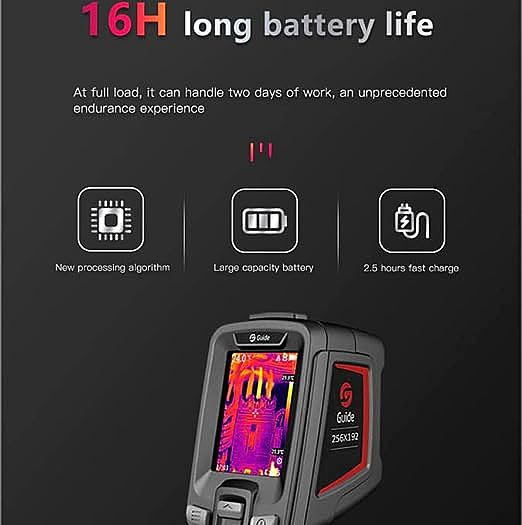
A tool that boasts impressive power is a technician’s dream. However, its real-world value is determined by its ability to perform consistently in the field. This is where specifications related to endurance and durability become paramount. The PC210’s claim of a 16-hour operating time is a headline feature. For a professional, this isn’t about convenience; it’s about workflow continuity. It means an inspector can confidently leave for a full day of back-to-back jobs without packing a charger or worrying about “battery anxiety,” eliminating a significant point of failure in their process.
This endurance is housed in a body designed for the rigors of a job site. Its IP54 rating translates to meaningful protection: it’s sealed against dust ingress that could harm internals and can withstand splashing water from any direction, meaning a light rain shower won’t end your workday. Combined with a 2-meter drop test certification, it provides a level of confidence that the instrument can survive the inevitable bumps and falls of a demanding environment. Furthermore, the 25Hz frame rate ensures a smooth, real-time view when scanning areas or observing moving machinery, a stark contrast to the choppy, disorienting image produced by the 9Hz cameras common at lower price points.
The Ecosystem and its Compromises: A Reality Check
In the world of engineering and product design, every choice is a trade-off. To deliver such a potent hardware package—a low-NETD VOx sensor, high resolution, and manual controls—at a sub-$500 price point, concessions are inevitably made. It’s crucial to examine these compromises to get a complete picture.
Based on initial hands-on reports, these trade-offs with the PC210 appear primarily in the software and user interface refinement. For example, while PC connectivity for live video streaming is a feature, users have noted it requires specific third-party software (like PotPlayer) and lacks the seamless integration of more mature ecosystems. Similarly, ergonomic quirks, like the operational logic of the built-in flashlight or the design of the SD card cover, have been pointed out. These are not hardware flaws, but they reflect a product philosophy that prioritizes core imaging performance over a polished, all-encompassing user experience.
Whether these compromises are acceptable depends entirely on the user’s priorities. A professional who requires a seamless, integrated software suite for generating polished client reports might find these issues frustrating and may lean towards a more expensive, established brand. However, a technician who prioritizes raw diagnostic power for in-field troubleshooting, and is willing to work around minor software quirks, may see this as an incredibly intelligent trade-off.
Conclusion: The Power of an Informed Decision
The Guide Sensmart PC210 serves as an excellent case study for a significant trend in the thermography market: the decoupling of core imaging performance from high price tags. It demonstrates that professional-grade resolution and sensitivity are no longer the exclusive domain of premium brands. However, it also highlights that the total value of a tool is an equation that includes not just the hardware specifications, but also the software ecosystem, user experience, and brand support.
Ultimately, the power lies not in any single product, but in your ability to understand this equation. By learning to look beyond the spec sheet and critically evaluate the entire package—the sensor, the controls, the physical design, and the software—you empower yourself to make an informed decision. You can identify the tool that offers the right set of strengths and trade-offs for your specific needs, ensuring that your investment, whether it’s for the PC210 or another imager, is a truly sharp one.