More Than Pixels: A Professional’s Field Guide to the FLIR C3-X

In the world of professional diagnostics, some problems are stubbornly invisible. They hide behind walls, inside electrical panels, or deep within mechanical systems, manifesting only as cryptic symptoms like a tripped breaker, an unexplainable cold spot, or a component that fails prematurely. For decades, troubleshooting these issues was a painstaking process of elimination. Today, our toolbox is smarter. It demands more than just sight; it demands insight. Thermal imaging provides that insight, but choosing the right tool is a decision that goes far beyond a simple spec sheet. This is not a review in the traditional sense. It’s a field guide for the working professional considering the FLIR C3-X Compact Thermal Camera. We won’t just list features; we will deconstruct it as a complete diagnostic system. The central question isn’t whether it has the most pixels, but whether it provides the most effective and reliable solution for identifying, documenting, and resolving problems in the demanding environments where you work. We will approach this by asking the hard questions you should be asking before investing in any professional tool.
Question 1: Is 128×96 Resolution Enough for Professional Work?
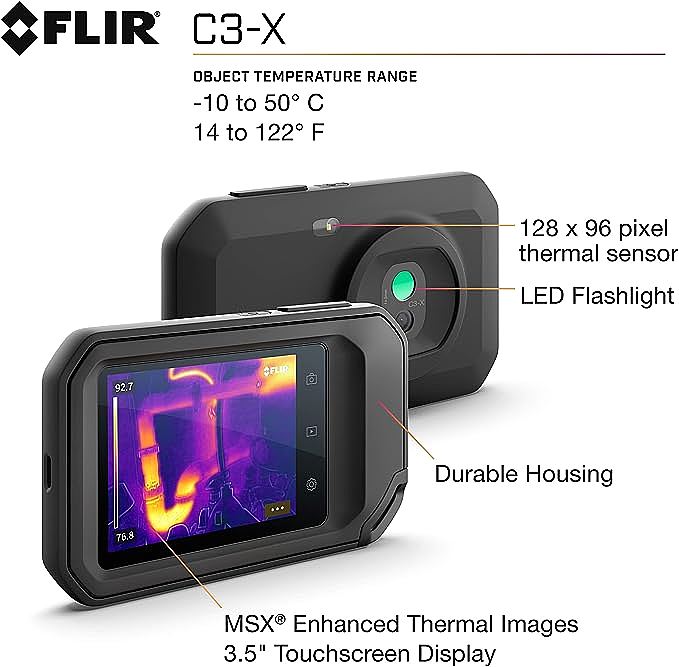
Let’s address the elephant in the room immediately: the 128 × 96 thermal sensor, which translates to 12,288 pixels. In an era of megapixel smartphone cameras, this number can seem underwhelming. It’s a valid concern, and for certain highly specialized applications, more physical resolution is indeed necessary. However, for the vast majority of electrical, mechanical, and building diagnostics, the effectiveness of a thermal image hinges less on raw pixel count and more on the clarity and context of the information presented. The C3-X’s strength lies not in a single specification, but in a system of technologies working in concert to deliver that clarity.
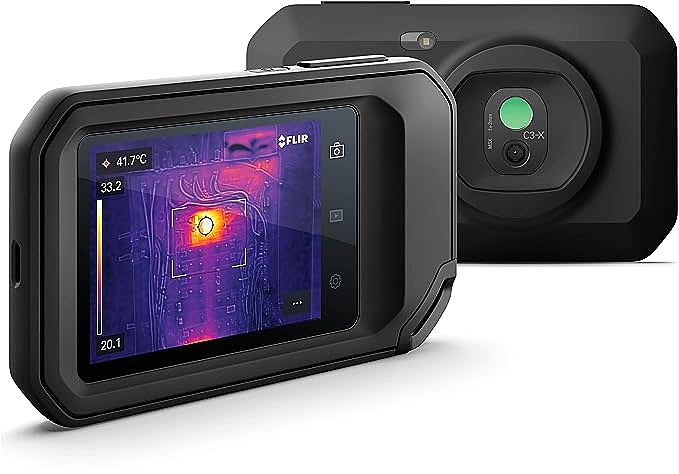
The first and most critical part of this system is FLIR’s patented MSX® (Multi-Spectral Dynamic Imaging) technology. Imagine a medical X-ray. It shows the bone structure clearly, but it can be difficult to tell exactly where that bone is in relation to the muscles and skin. Now, imagine a faint, sharp outline of the body’s anatomy sketched directly over that X-ray. Suddenly, everything clicks into place. This is precisely what MSX does. It uses the built-in 5-megapixel visual camera to detect the edges and details of objects in the scene—the outline of a circuit breaker, the frame of a motor, the seams of a duct—and embosses this high-contrast visual data directly onto the thermal image in real-time. In a cluttered electrical panel, a pure thermal image might show a confusing blob of heat. With MSX, you see that the hotspot is originating from the exact terminal screw on the third breaker from the left. It provides unambiguous context, turning a potentially vague thermal reading into actionable diagnostic information. This intelligent image enhancement makes each of those 12,288 pixels work much harder, often providing more practical usability than a higher-resolution image that lacks contextual detail.
The second part of the imaging system is its thermal sensitivity, or Noise Equivalent Temperature Difference (NETD). The C3-X has a sensitivity of <70 mK, meaning it can distinguish between temperature differences as small as 0.07°C. While resolution determines the spatial detail, sensitivity determines the thermal detail. This is crucial when looking for subtle issues, such as the faint, cool signature of moisture evaporating behind a wall or a minor insulation gap that, over time, contributes to significant energy loss. A camera with high resolution but poor sensitivity might miss these subtle thermal gradients entirely. The C3-X’s sensor is tuned to deliver the thermal nuance required for comprehensive building and system diagnostics. So, the answer to the resolution question is nuanced: for pinpointing issues within a clear structural context, the C3-X’s imaging system is not just adequate, but intelligently designed for the task.
Question 2: Will It Survive the Journey to the Job Site and Back?
An image is useless if the camera capturing it can’t survive the journey. Having a clear picture of a problem is one thing, but can the FLIR C3-X handle the physical realities of the modern job site? This is where many lower-cost thermal solutions, particularly smartphone-based attachments, reveal their limitations. A professional tool must be built with the expectation of being dropped, splashed, and covered in dust. The C3-X is engineered from the ground up with this in mind.
Its IP54 rating is not just a random collection of letters and numbers; it’s a specific promise of durability. The ‘5’ signifies a high level of protection against dust ingress—it’s not fully sealed, but enough is kept out to ensure it won’t interfere with operation. This means you can take it into a dusty attic or a workshop without constant worry. The ‘4’ signifies protection against water splashes from any direction. It won’t survive full submersion, but a sudden rain shower or a splash from a pipe won’t mean a trip to the repair center. Furthermore, the device is designed to withstand a 2-meter (6.6 ft) drop. This is the kind of real-world assurance that provides peace of mind. The cost of a tool is not just its purchase price; it’s the cost of downtime and replacement. The rugged, rubberized chassis of the C3-X is an investment in uptime. Its compact, pocket-portable design also means it’s more likely to be on your person when an unexpected issue arises, promoting proactive, preventative inspection rather than reactive repair.
Question 3: How Does It Actually Fit Into My Daily Workflow?
A tool that’s tough enough for the job is essential, but a truly great tool is one that also makes the job easier and faster. This is where we move beyond the hardware and look at how the C3-X integrates into your daily workflow, from the moment you take a picture to the second you send the report. Capturing an image is only the first step; the real value comes from analyzing, annotating, and sharing that data efficiently.
On-site, the 3.5-inch touchscreen provides a clear, bright interface for immediate analysis. Features like the center spot meter and the 1-Touch Level/Span, which automatically adjusts contrast to highlight issues in a specific area, allow for rapid diagnosis without needing to connect to another device. You can find the problem, show it to the client, and explain the next steps right then and there. But the workflow doesn’t end on-site. The C3-X is a gateway to the broader FLIR ecosystem, offering flexibility in how you manage your data.
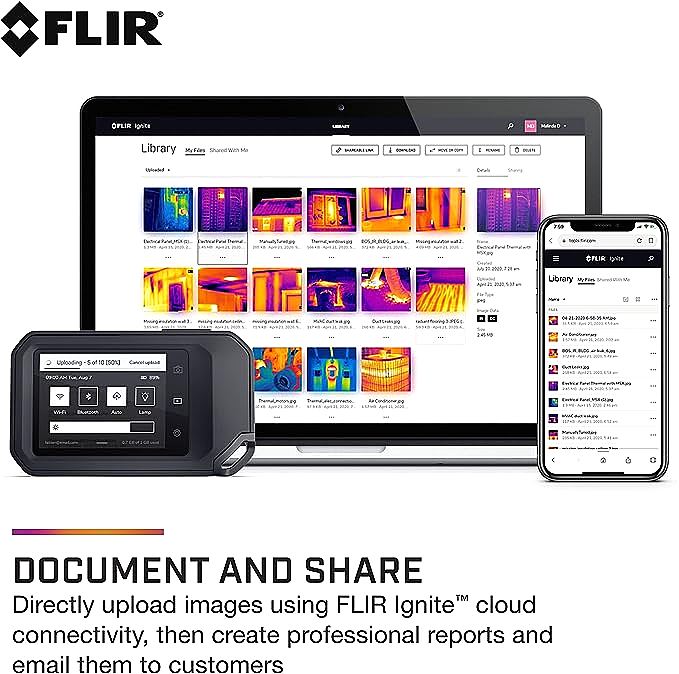
For those embracing a modern, connected workflow, the built-in FLIR Ignite™ cloud connectivity is a game-changer. With a Wi-Fi connection, you can directly upload images from the camera to your secure cloud storage. This serves as an instant backup, eliminating the risk of losing a day’s work if the camera is lost or damaged. It also means images are immediately accessible on your phone, tablet, or computer back at the office, ready to be inserted into a report. You can organize files by client or job, add notes, and create professional-looking reports to email directly to customers, significantly cutting down on administrative time. However, for situations without connectivity or for those who prefer a traditional approach, the C3-X is not restrictive. It has internal memory for over 5,000 images and a standard USB-C port for fast, simple file transfer to a computer, where the powerful FLIR Thermal Studio software can be used for in-depth analysis and advanced report generation. This dual-pronged approach—offering both cutting-edge cloud integration and reliable offline functionality—makes the C3-X adaptable to your specific work style and environment.
Question 4: Where Does It Excel, and What Are Its Limits?
No tool is perfect for every job. A wise professional knows not just the capabilities of their tools, but also their limitations. The FLIR C3-X finds its sweet spot as a powerful, first-line diagnostic instrument for a wide range of common applications. For building inspectors, it excels at quickly scanning for insulation defects, air leakage around windows and doors, and hidden moisture intrusion. For electricians and maintenance technicians, it is an invaluable tool for safely scanning breaker panels, transformers, and motors for overheating components that signal an impending failure. In HVAC applications, it can instantly visualize temperature differentials across coils, locate duct leaks, and verify system performance. It is the ideal go-to device for rapid troubleshooting and documentation in these core trades.
However, understanding its limits is key to avoiding frustration. The C3-X is not designed for long-distance thermography; its fixed-focus lens and resolution are optimized for inspections within a few meters. You would not use it to inspect a power line from the ground. Similarly, for highly granular tasks like analyzing the thermal performance of individual components on a dense printed circuit board, a dedicated benchtop camera with a macro lens and much higher resolution would be the appropriate tool. The C3-X’s purpose is not to be the ultimate authority for every niche thermography application, but to be the rugged, reliable, and highly competent thermal imager that you can always have with you.
Conclusion: Investing in a System, Not Just a Spec Sheet
In the final analysis, the decision to invest in the FLIR C3-X should not be made by comparing a single number on a spec sheet. Its true value emerges when you view it as an integrated system designed for the professional. It’s a system that balances adequate, context-rich imaging from its MSX-enhanced sensor with the on-the-job resilience of its IP54-rated, drop-tested body. It’s a system that respects your workflow, offering both the efficiency of cloud connectivity and the reliability of direct, offline access. For the professional who needs to quickly find hidden faults, document repairs, and clearly communicate findings to clients, the C3-X represents a powerful and intelligent balance of performance, durability, and efficiency. The right question to ask is not “How many pixels does it have?” but “Will this system make me better, faster, and more reliable at my job?” For a vast range of diagnostic tasks, the answer is a resounding yes.