Beyond the Naked Eye: A Practical Guide to Thermal Imaging in Building Maintenance

The constant hum of machinery, the flicker of fluorescent lights—these are the familiar senses of a facility in full swing. But what about the senses you lack? The silent, invisible glow of a failing electrical connection, the slow creep of moisture behind a pristine wall, or the imperceptible friction of a motor bearing grinding its way toward a catastrophic failure. According to a study by the U.S. Department of Energy, unplanned industrial downtime can cost facilities upwards of $50 billion annually. These aren’t just abstract figures; they represent the colossal financial impact of problems we often cannot see until it’s far too late. This is where the discipline of Predictive Maintenance (PdM) transitions from a trendy buzzword to a balance-sheet necessity, and at its very core lies the transformative power of thermal imaging.
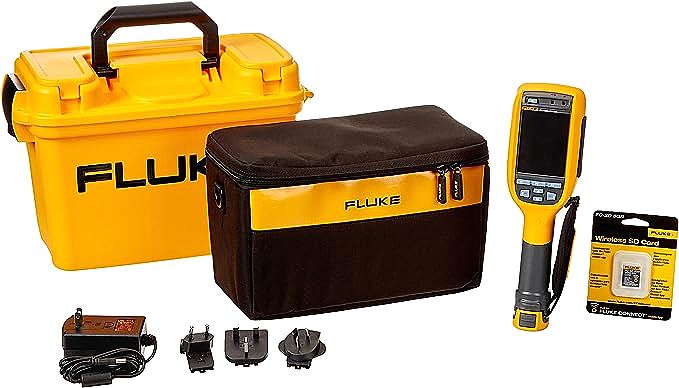
This guide is not a product manual. It’s an initiation into the mindset of a “building detective.” We will teach you how to see your facility not just with your eyes, but through the revealing lens of heat. You will learn to interpret the thermal landscape, identify anomalies, and diagnose problems before they halt your operations and drain your budget. To make this journey practical and grounded, we’ll use a reliable, no-nonsense workhorse as our case-study tool: the Fluke Ti100 General Purpose Thermal Imager. Forget the marketing hype; let’s learn how to solve real-world problems.
The Crime Scene: Where Invisible Culprits Hide
So, you’re convinced that invisible problems are a constant threat. But where do you even begin to look? Let’s put on our detective hats and start surveying the most common crime scenes in any facility, places where thermal imaging turns costly ambiguity into actionable intelligence.
Electrical Systems: The Silent Firestarter
The National Fire Protection Association (NFPA) consistently identifies electrical failures as a leading cause of commercial building fires. These failures rarely happen in a sudden, explosive event; they begin as a whisper of heat. A loose connection in a terminal block, an imbalanced load on a circuit, or a degrading breaker all generate excess heat long before they catastrophically fail. Standing in front of an energized electrical panel with an infrared camera is perhaps the single most impactful application of this technology. From a safe distance, you can instantly see the glowing thermal signature of a component under stress. When scanning a crowded panel, a feature like Fluke’s IR-Fusion® becomes invaluable. It intelligently overlays a visible light image onto the thermal one, allowing you to move from seeing a vague “hot spot” to identifying “the top lug on breaker C4” with absolute certainty. This is the critical difference between a generic warning and a precise, actionable work order.
Mechanical Equipment: The Slow Grind to Failure
For rotating equipment like motors, pumps, and conveyors, heat is a primary indicator of operational health. Abnormal friction from poor lubrication, bearing wear, or shaft misalignment translates directly into a higher operating temperature. A routine, non-contact thermal scan can be incredibly efficient and revealing. Instead of relying on intermittent vibration analysis or waiting for an audible sign of distress, you can quickly scan a row of identical motors and look for the one that’s running significantly hotter than its peers. This comparative analysis is one of the fastest ways to flag a machine for closer inspection. The immediate goal isn’t to measure the absolute temperature down to a fraction of a degree, but to rapidly identify the outlier that’s silently screaming for maintenance.
Building Envelope: The Energy and Structural Leaks
The integrity of your building itself is a critical, and often overlooked, asset. Hidden problems here manifest in two costly ways: massive energy loss and creeping structural damage. A thermal imager with solid thermal sensitivity—like the Ti100’s ability to detect differences of ≤0.10°C—can reveal these subtle but significant issues. A dark, cool pattern on an interior wall in winter could be a void in the insulation, a thermal bridge that is actively bleeding your heating budget dry. Conversely, a distinct pattern of coolness that follows gravity’s path from a ceiling penetration could be the tell-tale sign of moisture evaporation from a slow roof leak. This is a problem that, if left unchecked, can lead to widespread mold growth and costly structural repairs. Professionals performing these energy and moisture audits often follow established standards like ASTM E1186, which outlines procedures for this kind of diagnostic work, underscoring that this is a repeatable science, not a guessing game.
Your Detective’s Toolkit: Decoding the Fluke Ti100’s Arsenal
You’ve now seen the culprits, from overheated circuits to hidden moisture. But to effectively investigate them, you need the right set of tools. Let’s open up our detective’s toolkit and understand the key features of an imager like the Fluke Ti100, not as marketing bullet points, but as instruments for solving specific problems.
The Magnifying Glass – Resolution (160×120):
In a world obsessed with megapixels, a 160×120 (19,200 pixel) sensor might seem modest. This is a critical misunderstanding. The core principle for a maintenance professional is “Sufficient Detail.” Are you analyzing a microchip or finding a hot breaker? For the vast majority of facility tasks, 19,200 data points are more than enough to clearly identify a problematic connection, a failing bearing, or a significant area of water damage. This resolution hits the sweet spot between diagnostic capability and affordability, making professional-grade imaging accessible.
_Expert Caution: The Distance-to-Spot Ratio Trap_
Resolution isn’t just about a clear picture; it’s about accurate measurement. Every thermal imager has a “Distance-to-Spot” (D:S) ratio, which determines the smallest area it can accurately measure from a given distance. With a lower-resolution imager, if you stand too far from a small target (like a bolt on a busbar), the camera will average the target’s temperature with the surrounding cooler area, giving you a dangerously misleading low reading. Always ensure your target is several pixels wide in your image for an accurate measurement. For the Ti100, its 3.39 mRad spatial resolution means you can resolve a 1-inch spot from about 24 feet away—know your tool’s limits.
The Flashlight – Focus & Illumination (IR-OptiFlex™ & Laser):
Fuzzy images lead to bad conclusions. The Ti100’s IR-OptiFlex™ focus system offers a major efficiency boost: for anything beyond 1.2 meters (4 feet), it’s essentially a focus-free, point-and-shoot tool. This allows you to rapidly survey rows of equipment or large wall sections without constantly fiddling with a focus ring. For closer targets, you still have manual focus control. This hybrid approach streamlines inspections, while the built-in laser pointer helps you to physically pinpoint the identified problem area for a colleague or in a report photo.
The Fingerprint Kit – Image Blending (IR-Fusion®):
An infrared image shows you _what_ is hot, but often struggles to show you exactly _where_ it is. This is where image blending is a game-changer. IR-Fusion® technology captures a standard digital photo and an infrared image simultaneously. You can then blend them together, overlaying the thermal data on the visible details. A glowing orange blob becomes a clearly identifiable, overheating wire nut. This context is not a luxury; it is essential for accurate diagnosis and repair.
The Radio – Connectivity (Fluke Connect™):
In a modern workflow, data stuck on a device is a bottleneck. The ability to wirelessly sync images from the Ti100 to a smartphone or tablet via the Fluke Connect™ app fundamentally changes the game. You can share a critical finding with a remote manager for immediate approval of a shutdown, add images to a work order on the spot, and build a historical database of equipment health without ever returning to your desk. This accelerates the entire “find-to-fix” cycle.
Case Closed: From Thermal Image to Actionable Report
A detective’s work isn’t done after finding the clues. The most crucial step is presenting the evidence in a way that leads to a conviction—or in our case, a swift and correct repair. An image full of colorful spots is useless without proper analysis and a clear report. Using the accompanying SmartView® software, you can fine-tune your images, add annotations, and generate a simple report that clearly communicates three things: What is the problem (e.g., overheating connection), Where is it located (with a blended IR-Fusion® image), and How Severe is it (based on temperature data and established standards). The true return on investment of this tool is realized in this final step, where a report that took minutes to create prompts the proactive replacement of a 10 component, averting a 10,000 motor failure and the associated downtime.
Conclusion: Graduating from Technician to Building Detective
We began by acknowledging the costly, invisible threats that plague every facility. By now, you should see that thermal imaging is far more than a gadget that makes pretty, colorful pictures. It is a powerful diagnostic skill, and the camera is the tool that enables it. It empowers you to move from a reactive, “fix-it-when-it-breaks” maintenance schedule to a proactive, intelligent, and cost-effective predictive model.
Choosing the right tool for this job isn’t about chasing the highest numbers on a spec sheet. It’s about a clear-eyed assessment of your most frequent and critical tasks. For the professional who needs to quickly and reliably find the vast majority of electrical, mechanical, and building envelope issues without a five-figure investment, a rugged and straightforward general-purpose imager is not a compromise—it’s the smart, strategic choice. You are no longer just a technician; you are a building detective, and you now have the vision to see what others can’t.