
The Biomechanics of Wearable Cleaning: Tension, Torque, and the Shoulder-Vac Paradox
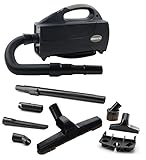
In the taxonomy of cleaning tools, the “shoulder-vac” or compact canister occupies a unique evolutionary niche. It attempts to bridge the gap between the raw power of a sled canister and the agility of a handheld unit. By strapping the motor to the user’s body, it promises the ultimate freedom of movement. However, this form factor introduces a complex set of physical interactions between the human body, the machine, and the operational environment. Analyzing these interactions reveals the delicate engineering balance required to create a tool that feels truly weightless.
The Center of Gravity and Skeletal Load
The primary ergonomic advantage of a shoulder-worn vacuum, like the Oreck BB1200DB, is the redistribution of mass. In a traditional stick vacuum, the motor, battery, and dust bin are often located at the handle. This creates a Class 3 lever, where the user’s wrist acts as the fulcrum. Even a light 3-pound weight at the end of a long lever arm creates significant torque on the wrist and forearm, leading to rapid fatigue.
By moving the bulk of the mass (in Oreck’s case, about 5.5 pounds) to the shoulder close to the body’s core, the moment arm is drastically reduced. The weight is supported by the axial skeleton (spine and hips) rather than the small muscle groups of the arm. This allows for extended cleaning sessions—vacuuming crown molding, ceiling fans, or drapes—without the “burning” sensation in the forearm. However, this introduces a new variable: the strap interface. If the strap is narrow or poorly padded, the localized pressure can compress the trapezius muscle. Effective design requires a wide, distributive strap to mimic the load-bearing principles of a hiking backpack.

The Physics of the Hose: Elastic Tension and Stability
The Achilles’ heel of any compact canister system is often the hose. This is where the physics of elastic tension comes into play. To keep the unit compact, manufacturers often use “slinky” style hoses that retract to a small size but can stretch to reach distant objects.
However, according to Hooke’s Law (F = -kx), the force required to extend a spring (or hose) increases linearly with the distance. As the user reaches further, the hose pulls back with increasing force. In a floor canister, the heavy unit acts as an anchor. But for a lightweight, wearable unit like the Oreck BB1200DB, this tension can be problematic. If the unit is set on the floor, a stiff or high-tension hose can easily pull the lightweight canister over, a frustration noted by some users. This creates a design paradox: the hose must be flexible enough to allow movement but rigid enough not to collapse under suction, all while having a low enough spring constant to prevent toppling the machine.

The Operational Envelope: Fluid Dynamics in Reverse
One of the most intriguing features of the compact canister class is the ability to reverse airflow, turning the vacuum into a blower. While this seems like a simple switch, it fundamentally changes the fluid dynamics of the tool.
When vacuuming (negative pressure), the air speed is highest at the nozzle entry and drops rapidly as distance increases. You cannot “pull” air from a specific distant point effectively; you must be close to the source. This is why vacuuming requires proximity.
When blowing (positive pressure), the air exits as a coherent jet (a laminar flow that eventually becomes turbulent). This jet maintains its velocity over a much longer distance. This physical difference expands the Operational Envelope of the tool. With the Oreck BB1200DB, the blower function allows the user to clean areas where the nozzle cannot physically fit—blowing dust out from behind radiators, deep inside computer cases, or from complex car dashboard vents—so it can settle in an accessible area to be vacuumed later. This duality transforms the device from a surface cleaner to a volumetric cleaner.
Tethered vs. Free: The Cord Management Challenge
In an age of lithium-ion dominance, a corded device seems anachronistic. Yet, from an engineering reliability standpoint, the cord is a feature, not a bug. It provides a constant, non-sagging voltage to the motor, ensuring that the 700th minute of operation is as powerful as the first.
However, the cord adds a “tethering” vector to the user’s movement. The user must subconsciously map the room, managing the radius of the 20-foot cord to avoid snagging. This requires a higher cognitive load than a cordless device but offers the trade-off of infinite runtime. For “process cleaners”—those who dedicate a specific block of time to deep clean the whole house—the cord is superior. For “snack cleaners”—those who clean in 30-second bursts—it is a hindrance. The Oreck BB1200DB is clearly designed for the former, prioritizing sustained power for detailed tasks over grab-and-go convenience.

Conclusion
The wearable vacuum is a study in physical compromise. It trades the convenience of cordless freedom for the reliability of AC power. It trades the simplicity of a stick vac for the ergonomic load-shifting of a shoulder strap. Understanding these trade-offs is key to user satisfaction. The Oreck BB1200DB excels when treated as a precision instrument for specific zones—upholstery, stairs, and detailing—rather than a general floor sweeper. It reminds us that in the world of physical tools, geometry and physics dictate comfort, and the most effective tool is one whose design constraints align perfectly with the task at hand.