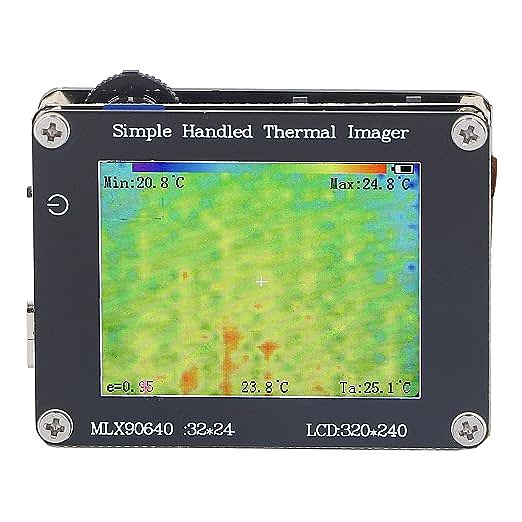
The Hidden Truth in a $70 Thermal Camera: Understanding the One Spec That Truly Matters

The promise is incredibly alluring: for less than the price of a new video game, you can wield a tool that lets you see the invisible world of heat. Devices like the Asixxsix Thermal Imager Camera, with its 2-inch digital display and a price tag hovering around $70, seem to democratize a technology once reserved for scientists and high-paid technicians. It beckons to every homeowner wanting to find a draft, every DIYer hunting for an overheating component, and every curious mind eager to explore a different spectrum of reality.
But amidst the promising specifications—a wide temperature range from -40°F to 572°F, onboard image storage, a rechargeable battery—a single, puzzling piece of feedback from a customer in Germany throws a wrench in the works. With a one-star rating, they claim the product is “de facto unbrauchbar” – effectively unusable. The reason? “The display has a resolution of 320×240,” the review reads, “the sensor itself has the measly resolution of 32×24.”
How can this be? How can a device with what sounds like a decent display be deemed useless? This discrepancy isn’t just a product flaw; it’s a doorway to the single most important lesson in the world of thermal imaging. It’s a mystery that, once solved, will arm you with the knowledge to make an informed decision on any thermal camera, at any price point. It’s time to investigate.
The Deceptive Duo: Sensor Resolution vs. Display Resolution
To unravel this puzzle, we must distinguish between two fundamentally different components of any digital camera, thermal or otherwise. The first is the sensor, the device’s true electronic eye. It’s a grid of detectors—in this case, a Melexis MLX90640 microbolometer array—that captures incoming infrared radiation and converts it into a grid of data points, or pixels. The second is the display, the screen you look at, which simply visualizes that data.
The Asixxsix camera’s sensor has a resolution of 32 pixels by 24 pixels. Let’s do the math: 32 x 24 equals a grand total of 768 pixels. This is the absolute maximum amount of unique thermal information the camera can capture at any given moment. This is its entire worldview.
Now, consider the display. Its resolution is 320 pixels by 240 pixels, which equals 76,800 pixels. That’s one hundred times more pixels than the sensor has. Herein lies the heart of the confusion and the genius of misleading marketing. The camera is performing a digital sleight of hand. It’s taking a tiny, 768-pixel mosaic of thermal data and stretching it across a vast, 76,800-pixel digital photo frame through a process called interpolation.
Imagine you have a beautiful, intricate postage stamp. Now, imagine you scan that stamp with an extremely low-quality scanner, capturing only a blurry, 768-pixel image of it. Finally, you display that blurry image on a massive, high-definition 4K television. Will the TV make the image of the stamp clearer? Will it magically reveal the fine print and delicate engravings? Of course not. It will simply show you a larger version of the same blurry, pixelated image. The large, impressive frame cannot invent detail that was never captured in the first place. This is precisely what’s happening here. The bright, colorful screen is just a big frame for a very, very small picture.

A Gallery of Ghosts: Visualizing Different Thermal Resolutions
Understanding the numbers is one thing, but what does this difference actually look like? Let’s step into a gallery and compare these thermal “photographs.”
A 32×24 (768 pixels) image is like a ghost. If you’re looking for a water leak behind a wall, you won’t see a damp spot; you’ll see a vague, indistinct blueish blob that might be several feet wide. If you’re inspecting an electrical panel, you won’t see an overheating screw terminal; you’ll see a general reddish smear in the vicinity of a circuit breaker. You have evidence of a thermal “presence,” but the details are almost entirely lost. Pinpointing the exact source of a problem is nearly impossible.
Now, let’s look at what is widely considered the true entry-level for a usable thermal imager: 80×60 (4,800 pixels). This is over six times more data. That indistinct blueish blob on the wall now starts to take shape, its edges become more defined, and you can narrow down the potential leak area significantly. The reddish smear on the electrical panel now resolves into a distinct hot spot, though you might still struggle to tell if it’s the wire or the connection itself.
Finally, consider a common professional standard, a thermal camera with a native 320×240 (76,800 pixels) sensor—the same resolution as the cheap camera’s _display_. This is a true high-definition thermal image. You can see the clear outline of moisture spreading from a specific pipe fitting. You can not only see the single overheating screw on the circuit breaker but also the heat bleeding into the connected wire. You have actionable, precise data.
The Supporting Cast of Critical Specs
While sensor resolution is the undisputed star of the show, a few other key specifications play critical roles in our thermal detective story. An entry-level device often compromises on these as well.
- Refresh Rate: This camera has an 8Hz refresh rate. This means the image updates only eight times per second. For a static scene, it’s manageable. But if you pan the camera across a wall to scan for issues, the image will appear jerky and laggy, like a choppy slideshow rather than a smooth video. Professional cameras often feature 30Hz or 60Hz rates for fluid, real-time feedback.
-
Thermal Sensitivity (NETD): This is arguably the second most important specification, and it’s almost never listed on ultra-cheap devices—a significant red flag. NETD (Noise Equivalent Temperature Difference) measures the smallest temperature difference the camera can detect, usually expressed in milliKelvins (mK). A lower number is better. A professional camera might have an NETD of <50mK, allowing it to “hear” the faint thermal “whisper” of subtle insulation issues. A low-cost sensor might have a much higher NETD, meaning it can only detect the thermal “shout” of a major problem, missing the early warning signs.
-
Emissivity Adjustment: Different materials radiate heat at different efficiencies. This property is called emissivity. A shiny piece of aluminum and a piece of black electrical tape, even at the exact same temperature, will look drastically different to a thermal camera. Good imagers allow you to adjust the emissivity setting to get accurate temperature readings from various surfaces. Basic devices often lack this feature, rendering their temperature measurements little more than a guess when looking at anything other than matte, non-metallic surfaces.

The Verdict: Is There Any Use for a 768-Pixel Thermal Eye?
After this deep dive, it’s easy to dismiss such a device as completely useless. And for most practical purposes, especially those requiring any degree of precision, that conclusion is largely correct. It is not a tool for a professional electrician, a plumber, or a serious home inspector.
However, in the spirit of intellectual honesty, let’s consider its extremely limited potential roles:
1. As an Educational Toy: It can brilliantly demonstrate the core principles of thermal radiation to a child or a student. You can show them how friction creates heat by rubbing their hands together or how a cold drink radiates “cold.”
2. For Gross Anomaly Detection: If you want to know if your furnace is, in a very general sense, “on,” it will show you a large hot rectangle. If you want to find a massive, gaping hole in your insulation where cold air is pouring in, you’ll see a large, obvious cold spot. It’s a tool for finding thermal mountains, not thermal molehills.
3. For Comparative Analysis: If you have two identical pumps running side-by-side, you might be able to tell that one is “generally hotter” than the other, signaling a potential issue for further investigation with proper tools.

Conclusion: The Real Investment Is Knowledge
Paradoxically, a 70 thermal camera like the Asixxsix might offer its greatest value not as a tool, but as a lesson. It is a masterclass in the importance of understanding specifications over marketing. It teaches you, in the most tangible way possible, that the number on the screen is not the number that matters. Your journey into the fascinating world of thermal imaging begins not with a purchase, but with a piece of knowledge. When you next browse for a thermal camera, whether it’s 100 or $10,000, your eyes will instinctively ignore the display size and hunt for one critical specification: the sensor resolution. That is the number that defines the clarity of the invisible world you’re trying to see. And armed with that knowledge, you’ve already avoided the most common and costly mistake a beginner can make.