The Automated Barista: How Technology is Democratizing the Art of Microfoam

For decades, the “Third Wave” of coffee was defined by a return to craftsmanship. It celebrated the skilled barista who could manually texture milk into velvety microfoam and pour intricate latte art. This skill, however, created a high barrier to entry for the home enthusiast. Learning to surf the steam wand, finding the perfect vortex, and listening for the “tearing” sound of paper requires patience and hundreds of liters of practiced milk.
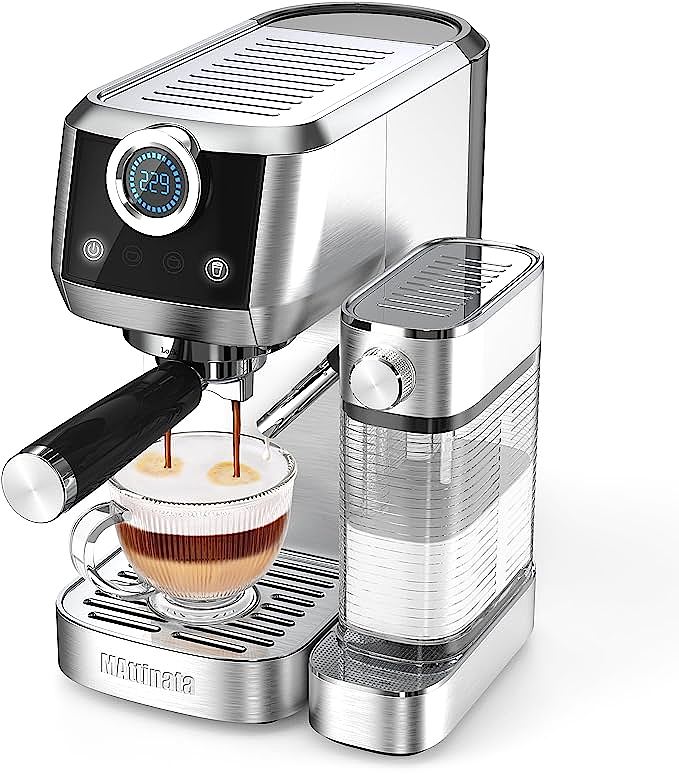
But the industry is shifting. We are entering a new era where technology is bridging the gap between convenience and chemistry. The rise of hybrid espresso machines, which combine traditional portafilters with automated milk frothing systems, signals a change in how we consume specialty coffee at home. It raises a fascinating question: Can an algorithm replicate the touch of a human hand? To answer this, we must dive into the microscopic world of milk proteins and the engineering of automation, exemplified by machines like the MAttinata CM1635.

The Chemistry of Texture: Protein Denaturation
To understand the challenge of automation, we first need to understand what “frothing” actually is. It is not just making bubbles; it is a chemical transformation. Milk contains proteins, primarily caseins and whey proteins. In their cold state, these proteins are folded structures.
When steam is introduced, two things happen simultaneously:
1. Heating: As temperature rises, the protein structures begin to unfold, a process called denaturation.
2. Aeration: Steam injects air into the liquid. The unfolded proteins, which have hydrophobic (water-repelling) and hydrophilic (water-loving) ends, rush to the interface between the air bubbles and the water. They form a film around the air, trapping it.
The goal is microfoam: a texture where the bubbles are so small they are invisible to the naked eye, creating a “wet paint” consistency. If the air bubbles are too large, the foam is dry and stiff (like old-school cappuccino foam). If the temperature gets too high (above 70°C/158°F), the proteins coagulate completely, and the foam collapses.
The human barista relies on sensory feedback—the sound of the steam, the heat of the pitcher against the palm—to navigate this chemical minefield. Automating this requires precise engineering control over thermodynamics and fluid dynamics.

The Engineering of Consistency: The Automatic Venturi
How does a machine like the MAttinata CM1635 automate this complex process? The secret lies in the Venturi effect and precise air injection.
Unlike a manual steam wand where the user controls the air intake by lowering the pitcher, an automatic system uses a mixing chamber. Steam is blasted through a narrow nozzle, creating a low-pressure zone. This vacuum sucks milk up from the reservoir (in this case, a 0.7L container) and simultaneously draws in a calibrated amount of air.
* The Mix: The steam, milk, and air collide in the mixing chamber at high velocity. The heat of the steam instantly denatures the proteins, while the turbulence creates the foam.
* The Adjustment: Advanced systems allow for variable foam density. A “Cappuccino” setting introduces more air for a thicker, drier foam. A “Latte” setting introduces less air for a silkier, liquid texture.
The MAttinata CM1635 simplifies this into a “Touch Panel” experience. The user selects the drink, and the machine executes a pre-programmed algorithm: dispense X seconds of frothed milk, followed by Y seconds of espresso extraction. This removes the variable of human error. You don’t need to know how to denature whey proteins; the machine’s fluid dynamics engineer has already figured it out for you.

The Convenience-Quality Matrix
In the coffee equipment market, there has always been a trade-off between convenience and quality.
* Pod Machines: High convenience, low textural quality.
* Semi-Automatic (Manual Wand): Low convenience (requires skill), high potential quality.
* Super-Automatic: High convenience, variable quality, high price.
Machines like the MAttinata CM1635 occupy a growing “Hybrid” sector. They offer the extraction quality of a semi-automatic (using a real portafilter and ground coffee) but the milk convenience of a super-automatic. This addresses a specific user behavior: many people love the ritual of tamping coffee but hate the mess and anxiety of steaming milk.
This hybrid approach democratizes beverages that were previously exclusive to cafes. A “Latte” is no longer a special treat purchased for $5; it is a reproducible commodity in the home kitchen. The 700ml detachable milk reservoir speaks to this utility—it’s designed for volume and storage, acknowledging that for families, efficiency is as important as flavor.

Hygiene: The Hidden Challenge of Automation
With automation comes the responsibility of maintenance. Milk is a biologically active substance. When left in narrow tubes at room temperature, bacteria multiply rapidly, and proteins harden into “milk stone” (calcium deposits).
Manual wands are easy to clean—you wipe and purge them. Automatic systems, however, have internal tubing. This makes the detachable nature of the system (seen in the CM1635) a critical feature, not just a convenience. Being able to remove the entire milk reservoir and store it in the fridge slows bacterial growth. Furthermore, the ability to disassemble the unit for cleaning ensures that the “convenience” of today doesn’t become the “clogged machine” of tomorrow.
The industry trend is moving towards self-cleaning cycles, but the fundamental discipline of hygiene remains. The “Science” of the machine only works if the biology of the milk is managed through cleanliness.
The Future of the Home Cafe
The popularity of automated milk systems reflects a broader societal trend: we demand professional results without professional training. We want the outcome (a delicious cappuccino) without necessarily mastering the process (steaming mechanics).
However, this doesn’t mean the death of the barista. Instead, it frees the home user to focus on the coffee beans themselves—their origin, roast profile, and grind size. By automating the milk texture, machines like the MAttinata CM1635 allow the drinker to appreciate the harmony of the beverage. It transforms the kitchen from a place of struggle (trying to get foam right) to a place of consistent enjoyment.
As technology evolves, we can expect these algorithms to get even better, perhaps one day adjusting the temperature based on the type of milk (oat vs. dairy) or the ambient humidity. But for now, the ability to press a button and watch physics and chemistry unite to create a perfect layer of foam is a modern marvel worth celebrating.
