
Digital Manometer vs Magnehelic vs U-Tube: A Pro’s Guide to Pressure Tools
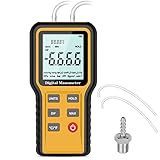
In a recent online review, a user of an affordable digital manometer made a telling comment: “Good accuracy, almost exact readings against 5 magnehelics.” This single sentence captures a crucial debate happening in toolbags and on job sites everywhere: in the world of low-pressure measurement, which tool truly reigns supreme?
Choosing a pressure gauge is like choosing a timepiece. Do you need a sundial—elemental and infallibly based on physics? A classic analog wristwatch—elegant, instantly readable, and always on? Or a modern smartwatch—packed with features, digitally precise, but dependent on a battery? Each has its place.
This guide will dissect these three archetypes of pressure measurement: the fundamental U-Tube Manometer (the Judge), the iconic Magnehelic-style gauge (the Sentry), and the modern Handheld Digital Manometer (the Detective). Our goal isn’t to crown a winner, but to arm you with the knowledge to choose the right tool for your specific mission.

The Judge: The U-Tube Manometer
At its core, the U-tube is physics made visible. It’s a clear tube bent into a ‘U’ and partially filled with liquid (usually water). When pressure is applied to one side, the liquid is displaced. The difference in height between the two columns is the pressure reading, in inches of water column. It is brilliantly simple and brutally honest.
Working Principle: Pure fluid statics. The measurement is a direct result of gravity balancing a pressure differential.
Strengths:
* Fundamental Accuracy: Its accuracy is based on the unchangeable density of the fluid and the laws of physics. It’s the gold standard against which other gauges are often calibrated.
* No Calibration Needed: As long as it’s clean and the liquid is pure, it’s accurate.
* Zero Power Consumption: It works forever without batteries.
Weaknesses:
* Cumbersome and Fragile: They are often large, must be held perfectly level, and can break easily.
* Hard to Read: Reading the meniscus, especially with small pressures, is difficult and prone to parallax error (reading it from an angle).
* Slow Response: The liquid takes time to settle, making it poor for observing rapid fluctuations.
Best Use Cases:
* The Lab: For scientific experiments and academic settings.
* The Calibration Bench: As a primary standard to verify the accuracy of other, more convenient gauges.
* Educational Purposes: There is no better way to teach the concept of pressure.
The Sentry: The Magnehelic-Style Differential Gauge
The Dwyer Instruments Magnehelic gauge (a brand name often used generically) is an icon of the HVAC industry. Its round face and clear pointer are instantly recognizable on the side of air handlers and in clean rooms everywhere.
Working Principle: It’s a masterpiece of analog engineering. A flexible diaphragm separates two pressure chambers. As pressure moves the diaphragm, a complex linkage connected to a magnet moves a helical spring, which in turn rotates the pointer. It’s purely mechanical.
Strengths:
* At-a-Glance Readability: The analog pointer gives an instant, intuitive sense of the pressure and its trends. You can “see” a filter loading up as the pointer slowly creeps higher over weeks.
* Extreme Durability: These gauges are built like tanks and can withstand vibration and harsh environments far better than a U-tube.
* No Power Required: Like the U-tube, it’s always ready to work.
Weaknesses:
* Limited Accuracy: Typically accurate to ±2% of full scale, which is excellent for monitoring but less so for precise diagnostics.
* Susceptible to Shock: A significant drop can knock the mechanism out of calibration.
* Single Unit, Fixed Range: You buy a gauge for a specific range (e.g., 0-1.0 inWC). It can’t measure outside that range or switch to another unit.
Best Use Cases:
* Permanent Monitoring: Ideal for fixed installation to monitor filter status, duct static pressure, or room pressurization. It’s the perfect “sentry,” always on watch.
* Air Balancing: Where quick, visual confirmation of airflow adjustments is needed.
The Detective: The Handheld Digital Manometer
The modern digital manometer, exemplified by affordable units like the Leaton Manometer, represents a revolution in accessibility and precision.
Working Principle: At its heart is a piezoresistive pressure sensor. This tiny silicon diaphragm flexes under pressure, changing its electrical resistance. A sensitive circuit measures this change and converts it into a digital number.
Strengths:
* Superior Accuracy and Resolution: Even inexpensive models can offer accuracy of ±0.3% of full scale, an order of magnitude better than many analog gauges. They can reliably read tiny increments (e.g., 0.01 inWC).
* Eliminates Reading Error: The number on the screen is unambiguous. No parallax, no guesswork.
* Multi-Unit Versatility: Instantly switch between inWC, Pascals, PSI, and more. This is invaluable for working with diverse equipment specs.
* Portability and Features: They are compact, lightweight, and often include functions like Data Hold, Min/Max capture, and auto-power off.
Weaknesses:
* Requires Power: A dead battery means a dead tool.
* Requires Calibration: For professional use, digital sensors need periodic calibration to ensure their accuracy hasn’t drifted.
* Can Be Less Intuitive for Trends: Watching numbers flicker on a screen can be less intuitive for spotting a trend than watching a steady analog needle.
Best Use Cases:
* Field Diagnostics: For any task requiring a precise, definitive reading, from setting furnace gas pressure to measuring draft. It’s the “detective” you send in to find the facts.
* System Commissioning: When setting up new HVAC systems to exact specifications.
Head-to-Head: The Decision Matrix
| Feature | U-Tube Manometer (The Judge) | Magnehelic Gauge (The Sentry) | Digital Manometer (The Detective) |
|---|---|---|---|
| Accuracy | Highest (Fundamental) | Good (Typically ±2% FS) | Very High (Typically ±0.3-0.5% FS) |
| Readability | Poor (Parallax error) | Excellent (Analog needle) | Excellent (Digital display) |
| Durability | Poor (Fragile) | Very Good (Robust) | Good (Electronic) |
| Portability | Poor (Bulky, liquid-filled) | Fair (Bulky but rugged) | Excellent (Compact, lightweight) |
| Versatility | Poor (Single unit, manual) | Poor (Single unit, fixed range) | Excellent (Multi-unit, features) |
| Power Needed | No | No | Yes (Battery) |
| Best For | Calibration, Education | Permanent Monitoring | Field Diagnostics, Commissioning |
The Budget Consideration
- U-Tube: Very low initial cost (20-50). Zero long-term cost.
- Magnehelic Gauge: Moderate initial cost (50-150 depending on range). Very low long-term cost.
- Digital Manometer: The entry point has plummeted. Tools like the Leaton offer professional-level accuracy for under $50. Professional models from brands like Fluke or Testo can cost several hundred dollars. The main long-term cost is periodic professional calibration.

Conclusion: The Right Tool for a Professional Toolbox
The debate over “digital vs. analog” is the wrong one. A truly professional approach recognizes that these tools are not competitors; they are colleagues. The U-tube is the ultimate source of truth, the Magnehelic is the tireless watchman, and the digital manometer is the brilliant field investigator. While the digital “detective” is arguably the most versatile and essential tool for modern diagnostic work, a wise technician understands the timeless value of the “judge” and the unwavering reliability of the “sentry.” The real answer is not which tool is best, but knowing your mission well enough to choose the right one.