
The Material Science of a Perfect Seal: How New Tech Grips Porous Surfaces like Stone and Drywall
In the world of vacuum lifting, glass is the “easy” problem. It is flat, smooth, and non-porous. It offers a perfect surface for a vacuum seal. But the vast majority of a job site—concrete, stone, drywall, plywood—is the exact opposite. These materials are the “impossible” problem.
They are textured, uneven, and porous. Trying to create a vacuum on them is like trying to drink from a straw full of holes.
For decades, this impossibility was accepted. The reason vacuum lifters couldn’t grip these surfaces wasn’t a failure of the pump, but a failure of the material science of the seal itself.

The Traditional Solution: The Elastomer (Rubber) Seal
The classic suction cup is made from an elastomer, like nitrile or silicone rubber. Elastomers are fantastic materials: they are durable, flexible, and create a strong, airtight seal on smooth surfaces.
However, they have one critical limitation: they are non-compressible.
While flexible, rubber doesn’t change its volume. When you press a rubber seal against a surface, it deforms, but it doesn’t “squish.”
Think of it like this: Place a hard coin on a piece of crinkled paper. The coin will only touch the highest “peaks” of the paper. Underneath it, there are countless “valleys” and tunnels connecting one side to the other.
This is precisely what happens with a rubber seal on a textured surface like stone or concrete. The rubber rests on the micro-peaks, but it cannot flow into the micro-valleys. These valleys become microscopic highways for air to rush in, breaking the vacuum in milliseconds.
The Material Breakthrough: Closed-Cell Conformable Foam
The solution to the “crinkled paper” problem required a completely different type of material. The breakthrough came from closed-cell conformable foam.
This is not like an open-cell sponge, which is designed to let air pass through. In a closed-cell foam, each tiny air bubble is a discrete, sealed pocket.
The properties of this material are game-changing:
- It is Conformable: Unlike rubber, this foam is soft and pliable.
- It is Compressible: Because it’s made of sealed air bubbles, you can “squish” it, and it will change its volume.
Now, let’s replay our analogy: Place a ball of soft bread dough on the same crinkled paper. When you press down, the dough doesn’t just rest on the peaks. It flows into every single peak, valley, and crevice, perfectly contouring to the paper’s exact shape.
This is what the closed-cell foam seal does. When a vacuum pump pulls it against a concrete block, the foam compresses and flows into the micro-texture of the concrete, “damming” up the microscopic air tunnels.
The “Tortuous Path” Theory
This “damming” effect is what engineers call creating a “tortuous path.”
- With a rubber seal, the air leak path is a short, straight, easy line from the outside to the inside.
- With a foam seal, the air must navigate a complex, winding, and difficult maze to get through.
The foam doesn’t stop 100% of the leaks, but it slows the leak rate by several orders of magnitude. It turns a “gushing river” of air into a “slow drip.”

The System Solution: Foam + Pump
This slowing of the leak is the key. On its own, a foam seal would still eventually fail. But it slows the leak so much that a small, efficient, battery-powered vacuum pump can easily overcome it.
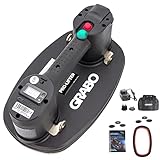
This is the system used by modern portable lifters like the GRABO.
- The Foam Seal conforms to the material (e.g., wood) and slows the leak to a manageable drip.
- The Smart Sensor detects the pressure loss from that tiny drip.
- The Active Pump turns on for a fraction of a second to pump the leaked air out, restoring the vacuum.
This harmony between advanced material science (the foam) and smart mechatronics (the pump) is what finally solved the “impossible problem.” It allows us to harness the full power of atmospheric pressure on almost any surface, opening up new frontiers in safety and efficiency for materials handling.