
The Unseen Force That Rips Bridges Apart—And Keeps Your Bike Rack Stable
A deep dive into resonance, the destructive ghost in the machine, and the elegant principle of ‘preload’ that keeps our world from shaking apart.
On the morning of November 7th, 1940, the third-longest suspension bridge in the world began to dance. The Tacoma Narrows Bridge, nicknamed “Galloping Gertie” for its unusual flexibility, had met its match in a steady 40-mile-per-hour wind. But it wasn’t the wind’s power that was the problem; it was its rhythm. The wind pulsed against the bridge deck at a frequency that perfectly matched the structure’s own natural willingness to twist.
What began as a gentle ripple escalated into a violent, uncontrollable oscillation. The massive steel and concrete roadbed twisted like a ribbon, heaving up and down in waves over 28 feet high. Four months after it opened to the public, the colossal structure tore itself apart and plunged into the Puget Sound below.
The culprit was not a flaw in the materials, nor a failure of brute strength. The bridge was destroyed by an invisible, relentless force of physics: Resonance.
Resonance is the ghost in the machine. It’s the phenomenon where a relatively small, rhythmic input can produce an enormous, often catastrophic, vibration in an object if the input frequency matches the object’s natural frequency. Think of pushing a child on a swing. You don’t need to shove them with immense force; you just need to apply small, gentle pushes at the exact right moment in the swing’s arc. Your timed pushes add energy to the system, and the swing goes higher and higher.
For the Tacoma Narrows Bridge, the wind provided those perfectly timed pushes. For the world of engineering, it provided a terrifying, unforgettable lesson: vibration, left unchecked, is not a nuisance. It’s an existential threat.

The Whisper That Becomes a Roar
You don’t need a suspension bridge to witness the insidious power of resonance. You’ve seen it in a table leg that needs tightening, creating an annoying wobble every time you type. You’ve heard it in the hum of a ceiling fan with an unbalanced blade. And if you’ve ever driven on the highway, you’ve almost certainly had a front-row seat to one of its most common and nerve-wracking performances: the violently shaking hitch-mounted bike rack.
The sight is a familiar one. A car cruises along at 70 mph, and the bicycles hanging off the back are engaged in a frantic, terrifying dance. They sway, they bounce, they shudder. You instinctively give the car a wide berth, half-expecting to see a bicycle cartwheel across the lanes of traffic.
Why does this happen? The bike rack acts as a cantilever beam—a lever fixed at one end and free at the other. This structure is inherently prone to amplifying motion. The tiny, repetitive vibrations from the road surface, the engine, and the wind travel through the car’s frame and into the hitch. Most of these vibrations are harmless noise. But occasionally, the frequency of this “noise” will align with the natural frequency of the loaded bike rack.
Just like the child on the swing, the rack begins to oscillate. Each tiny bump in the road adds a little more energy, and the sway gets bigger. The whisper of a vibration becomes a roar. This isn’t just unnerving; it’s dangerous. This constant, violent shaking is precisely the kind of cyclical stress that leads to metal fatigue, a phenomenon where material can fracture and fail far below its theoretical maximum strength.
So, how do you fight a ghost? How do you stop a force that feeds on rhythm and amplifies itself? You don’t overpower it. You starve it at its source.

The Engineer’s Secret Weapon
The engineer’s counter-move to the chaos of vibration is a principle as elegant as it is powerful: Preload.
Preload, or clamping force, is a profoundly simple concept with world-changing implications. Imagine trying to slide one heavy textbook off another. It’s relatively easy. Now, imagine someone is standing on the top book, pressing it down with their full body weight. Suddenly, sliding it is nearly impossible. That downward force is the preload.
In engineering terms, preload is the tension applied to a fastener, like a bolt, before it experiences any of its operational loads. When you tighten a bolt in a joint, you are stretching it like a very stiff spring. This stretching creates a powerful clamping force that squeezes the connected parts together.
This “squeeze” does two critical things. First, it dramatically increases the static friction between the surfaces. The force of friction is proportional to how hard the surfaces are pressed together; by aggressively clamping them, you make it incredibly difficult for them to have any relative micro-movements. Second, it completely eliminates any gaps or play within the joint.
Vibration needs movement to exist. Even the tiniest air gap allows a joint to start rattling. This rattle is the first whisper. Preload crushes that gap into non-existence. It creates a solid, unified structure where there was once a collection of separate parts. It kills the whisper before it has a chance to become a roar.
This isn’t just about making things feel “solid.” It’s a fundamental strategy for preventing fatigue failure. By stopping the micro-vibrations, preload protects the metal from the millions of stress cycles that would otherwise lead to cracks and catastrophic failure.
A Masterclass in Action
This brings us back to the highway and that wobbly bike rack. The primary source of the wobble is almost always the connection point: the shank of the rack inside the car’s square hitch receiver. A standard hitch uses a simple, smooth pin that slides through holes to keep the rack from falling out. While effective at that one job, it does nothing to prevent the shank from rattling around inside the receiver. There is an inherent gap, and that gap is an open invitation for resonance to start its destructive dance.
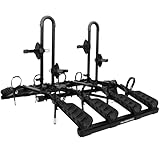
Now, consider an elegant application of preload, perfectly illustrated by a design like the Hollywood Racks Destination hitch rack. This rack, and others of its kind, eschew the simple pin for a threaded hitch pin.
This component is not a pin; it’s a bolt.
As you tighten it with a wrench, it doesn’t just pass through the hole. It screws into a threaded block inside the rack’s shank, actively pulling the entire shank against the inside wall of the hitch receiver. This action generates an immense clamping force—a powerful preload. The gap is eliminated. The friction is maximized. The rack and the hitch become, for all intents and purposes, a single, solid piece of steel.
The path for the destructive vibrations is severed. The road noise still enters the hitch, but it can no longer create the initial rattle needed to excite the rack’s natural frequency. The ghost has been exorcised, not with brute force, but with the quiet, constant, unyielding pressure of a simple screw thread. It’s a textbook execution of one of mechanical engineering’s most vital principles, hidden in plain sight on the back of a family car.

The Unseen Architecture of Stability
Once you understand the principle of preload, you start to see it everywhere. It is the unseen architecture that holds our high-performance world together.
Every critical bolted joint on an airplane’s wing and in its jet engines relies on precisely calculated preload to resist the incredible vibrations of flight. The massive bolts holding the steel skeleton of a skyscraper together are tightened to a specific tension to ensure the structure behaves as a single, solid frame. The head bolts clamping down on your car’s engine must maintain their preload through thousands of explosions per minute to prevent catastrophic failure.
The lesson from Galloping Gertie was not that wind is dangerous, but that vibration is relentless. The solution, embodied in a simple threaded pin, teaches us something even more profound: the most effective engineering is often invisible. It’s not about adding more material or more complexity. It’s about the clever application of fundamental physics to create a state of unyielding, silent stability. It’s the constant, steady squeeze that keeps the chaos at bay.