
The Ghost in the Glass: How a Forgotten Physics Trick Created the World’s Most Advanced Sight
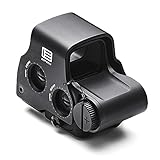
Imagine a small window of glass. It’s been hit. A spiderweb of cracks spreads across its surface, and a chunk is missing altogether. Yet, when you look through it, the image it projects—a precise aiming circle and dot—hangs in the air, perfectly whole, unwavering, and superimposed on a target 100 yards away.
This isn’t magic. It’s not a clever display screen. It’s the ghost of a Nobel Prize-winning physics idea, an idea that languished in obscurity for nearly two decades, waiting for another world-changing invention to bring it to life.
This is the story of holography. And how, in one of its most extreme and robust applications, the EOTECH Holographic Weapon Sight (HWS), it does more than just help someone aim. It offers a masterclass in the physics of light, information, and resilience. To understand this piece of technology, we first have to forget almost everything we think we know about creating an image and travel back to a London laboratory in 1947.

A Ghost From the Past
A Hungarian-British physicist named Dennis Gabor was wrestling with a problem. He wanted to improve the resolution of the electron microscope, to see the atomic lattice of a crystal directly. The problem was that the electron lenses were imperfect. He had a radical idea: What if, instead of trying to get a perfect image directly, he recorded all the light wave information scattered from the object—both its brightness (amplitude) and, crucially, its phase (the timing of the wave crests and troughs)? He could then use this complete recording, which he called a “hologram” (from the Greek holos, meaning “whole”), to reconstruct the original light wave in its entirety, later correcting for the lens aberrations.
He succeeded, in a way. He created the first hologram. But the result was faint, blurry, and plagued by ghostly artifacts. The problem wasn’t his theory; it was his tools. The light sources of the day, like mercury arc lamps, were chaotic. They were like a crowd of people all shouting different words at different times. To record the subtle interference patterns that a hologram requires, Gabor needed a light source that was orderly, disciplined, and pure—a source where all the light waves marched in perfect lockstep.
He needed, in other words, a laser. But the laser wouldn’t be invented by Theodore Maiman until 1960. And so, Gabor’s brilliant, Nobel-worthy idea remained a scientific curiosity, a ghost in the machine of mid-century physics, waiting for its moment to emerge from the shadows.
The Secret Language of Light
To grasp why the laser was the missing key, we have to understand the secret language that Gabor was trying to record. It’s a language written not in ink, but in the fundamental wave nature of light itself.
Imagine dropping two pebbles into a still pond. Each creates an expanding series of concentric ripples. Where the crest of one wave meets the crest of another, they combine to create a much higher wave. Where a crest meets a trough, they cancel each other out, leaving the water flat. This beautiful, complex pattern of peaks and nulls is interference. It’s the result of adding waves together.
Holography uses this exact principle. To create a hologram, you split a single laser beam in two. One beam, the “reference beam,” travels directly to a photographic plate. The other, the “object beam,” illuminates the object you want to record and then scatters onto the same plate. What gets recorded on the plate is not a picture of the object, but the incredibly fine, microscopic interference pattern created where these two laser beams—one pristine, one “imprinted” with the object’s information—meet. It’s a complex web of light and dark fringes that looks like meaningless static to the naked eye.
But this pattern is the code. It’s the object’s entire three-dimensional light signature, frozen in time. And to decode it, you use another fundamental property of light: diffraction.
Diffraction is the tendency of a wave to bend and spread out when it passes through a narrow opening. When you shine a laser (ideally, the same kind of laser used to create the hologram) back through the developed photographic plate, the light diffracts as it passes through the millions of tiny, recorded interference fringes. Miraculously, this process reverses the original recording step. The light waves are “unscrambled,” and they reconstruct a perfect, three-dimensional copy of the original object’s light field, appearing to float in space where the object once was.
You’ve just witnessed the ghost being brought back to life.

Two Kinds of Reality: Holography vs. Reflection
This is what sets a holographic sight apart from the far more common “red dot” or reflex sight. A red dot sight is a clever, but fundamentally simple, optical trick. It uses an LED to project a dot onto a specially coated, curved piece of glass that acts as a mirror, collimating the light. This means it bounces the light back to your eye in parallel rays, making the dot appear to be at a very distant point. It’s an elegant illusion, a 2D reflection.
A holographic sight like the EOTECH performs a far more profound feat. There is no reflection. The laser inside the sight is reconstructing a wavefront of light. The image of the reticle you see isn’t on the glass; it’s a true, three-dimensional virtual image that is projected out to the target’s plane.
This single distinction has massive implications.
First, it creates a true “Heads-Up Display.” Your focus doesn’t need to shift between a reticle floating a few inches from your face and a target a hundred yards away. Your brain perceives both on the same focal plane. This reduces eye strain and dramatically increases situational awareness because you can keep both eyes open, with the reticle naturally superimposed over your field of view, just like a fighter pilot’s HUD.
Second, it eliminates parallax error almost entirely. With a reflex sight, if you move your head off-center, the dot can appear to move slightly relative to the target. With a holographic sight, because the reticle image is co-located with the target in virtual space, it stays put. If you can see the reticle through any part of the window, you know precisely where you’re aiming.
The Ghost in the Glass, Revisited
Now we can return to our shattered window. The reason the projected reticle remains whole is one of the most mind-bending properties of holography: information is stored globally.
Think of a normal photograph. If you cut it in half, you lose half the picture. The information is localized. In a hologram, every single point on the recording plate receives light scattered from every single point on the object. The entire interference pattern, while complex, is distributed across the entire surface.
This means if you cut a hologram in half, you don’t get half an image. You get the whole image, just from a slightly diminished perspective and with slightly lower resolution.
This isn’t just a party trick; it’s the core of the EOTECH’s legendary durability, encapsulated in their motto, “Never Out of the Fight.” The sight’s window can be caked in mud, obscured by snow, or even partially shattered, and it will continue to project a complete, usable reticle from whatever portion of the holographic plate remains intact. It is a system where catastrophic failure is almost a physical impossibility, a direct consequence of the distributed nature of holographic information.
When Physics Meets Flesh
Of course, no technology exists in a vacuum. The perfection of physics must contend with the imperfections of the real world—including our own biology.
One of the most fascinating aspects of holographic sights is their interaction with astigmatism, a common vision impairment where the eye’s cornea or lens has an irregular shape. Because the holographic reticle is reconstructed from a pure, coherent laser source, it can exacerbate these imperfections. To an eye with astigmatism, the perfectly crisp 1-MOA (Minute of Angle) dot might appear fuzzy, streaked, or like a tiny starburst. It’s a powerful reminder that perception is an active process, a negotiation between incoming physical data and the biological instrument receiving it.
There’s also the unavoidable currency of energy. Reconstructing a ghost from light is more demanding than simply turning on a light bulb. The laser diode and complex electronics required to maintain a stable hologram consume more power than the simple LED in a red dot sight. This results in a shorter battery life—hundreds or thousands of hours, versus tens of thousands for some reflex sights. It is the price paid for the superior optical performance, a direct trade-off governed by the laws of thermodynamics.

Beyond the Reticle
From a forgotten idea in a post-war London lab, to the shimmering dove on your credit card, to the heart of an incredibly rugged optical instrument, holography is a testament to the power of a single, elegant physical principle.
The EOTECH sight is more than just an advanced tool. It is a physical manifestation of Gabor’s delayed legacy. It’s a device that weaponizes the physics of wave interference and leverages the principle of distributed information to create a system of unparalleled resilience. It’s a constant, silent demonstration that the most powerful ideas are not always the newest, but are often the ones that have been waiting patiently for the right moment—and the right technology—to finally show their true form. It is a lesson in physics, written in light, and encased in a box of glass and aluminum. A ghost, finally, given its perfect machine.