
The Economics and Ecology of the Home Café: Navigating the Single-Serve Revolution

In the landscape of modern consumption, few shifts have been as swift and impactful as the rise of the single-serve coffee ecosystem. It has fundamentally altered how we purchase, prepare, and perceive our daily caffeine intake. However, this convenience comes wrapped in complex layers of economic and environmental implications.
While the engineering marvels of machines like the KIDISLE CM9429D-UL 3 in 1 Single Serve Coffee Maker solve the immediate problem of time and space, they also position the consumer at a crossroads. One path leads to the high-cost, high-waste world of disposable pods; the other leads to a sustainable, cost-effective hybrid model of brewing.
This article delves beyond the mechanics of the machine to explore the socio-economic ecosystem of home brewing. We will analyze the “Razor and Blade” business model, calculate the true long-term cost of convenience, examine the environmental footprint of our brewing habits, and discuss the psychology of the “coffee corner” in modern interior design.
The “Razor and Blade” Model vs. Open Architecture
For years, the single-serve coffee market was dominated by a closed ecosystem strategy, famously known in business schools as the “Razor and Blade” model. Companies would sell the machine (the razor) at a loss or low margin, locking the consumer into purchasing their proprietary, high-margin pods (the blades) forever.
The Shift to Open Architecture
The introduction of “3-in-1” systems represents a disruptive shift towards what we call Open Architecture Brewing. By including adapters for generic K-Cups, ground coffee, and tea leaves right out of the box, machines like the KIDISLE dismantle the monopoly of the pod.
This shift is significant for the consumer economy. It transforms the coffee maker from a “subscription enforcement device” into a versatile tool.
* The Freedom of Choice: You are no longer beholden to the roasts offered in plastic cups. You can visit a local roastery, buy fresh beans, grind them yourself, and brew them in the single-serve machine.
* The Demise of Vendor Lock-in: This forces pod manufacturers to compete on quality and price, rather than relying on hardware incompatibility to retain customers.
This democratization of the hardware layer is a crucial development in the home appliance market, signaling a maturing industry where consumer demand for flexibility outweighs the corporate desire for control.
The Mathematics of Morning: A Long-Term Cost Analysis
Let’s break down the economics. The sticker price of a coffee maker is often the least significant number in the equation of ownership. The real cost lies in the Cost Per Cup (CPC) over the machine’s lifespan.
Scenario A: The Disposable Pod User
The average price of a branded K-Cup pod fluctuates, but let’s estimate it conservatively at $0.75 per pod.
* Daily Consumption: 2 cups.
* Annual Cost: $0.75 * 2 * 365 = $547.50.
Over a typical 3-year lifespan of a machine, the “fuel” cost is nearly $1,650. This is staggering when compared to the initial cost of the hardware (often under $70).
Scenario B: The Ground Coffee User
Now, let’s analyze the economics of using the reusable filter basket included with versatile machines.
* A 12oz bag of high-quality specialty coffee costs around $15.
* 12oz is approx. 340 grams.
* A standard single cup uses ~12 grams of coffee.
* Yield per bag: ~28 cups.
* Cost Per Cup: $15 / 28 $0.53.
This saves roughly 0.22 per cup. But if we look at standard grocery store coffee (approx. 8 for 12oz), the CPC drops to $0.28.
* Annual Cost (Standard Coffee): $0.28 * 2 * 365 = $204.40.
The Verdict: By utilizing the “Ground Coffee” function of a 3-in-1 machine, a household saves over $340 per year compared to pods. Over three years, that’s over $1,000 in savings—enough to buy a high-end grinder and a lifetime supply of filters. This mathematical reality highlights why the “flexibility” of the KIDISLE CM9429D-UL is its most valuable economic feature.
The Ecological Footprint: Plastic vs. Permanence
Beyond the wallet, there is the world. The environmental impact of single-serve coffee has been a subject of intense debate. Billions of plastic pods end up in landfills every year. They are technically recyclable, but their small size and composite nature (plastic cup, aluminum lid, organic coffee grounds) make them difficult for municipal recycling facilities to process effectively.
The Sustainability of the Permanent Filter
The inclusion of a permanent mesh filter changes the ecological calculation entirely.
1. Zero Plastic Waste: Brewing with grounds generates only wet coffee grounds as waste.
2. Compostability: Used coffee grounds are nitrogen-rich and excellent for composting. Instead of a plastic cup in a landfill, the byproduct becomes fertilizer for your garden.
3. Manufacturing Energy: The energy required to manufacture, fill, seal, and ship thousands of individual pods is astronomically higher than shipping a single bag of beans.
For the environmentally conscious consumer, the “3-in-1” capability is not just about flavor; it is an ethical imperative. It allows the convenience of single-serve brewing (speed, portion control) without the associated guilt of single-use plastic. It bridges the gap between the “fast culture” of the 21st century and the “slow living” principles of sustainability.
Spatial Design Psychology: The Coffee Corner
Finally, we must consider the machine’s role in our physical environment. In modern interior design, the kitchen counter is high-value real estate. The trend towards micro-living and smaller urban apartments has necessitated a new design philosophy: Functional Minimalism.
The Theory of Function Density
We mentioned “function density” in the engineering context, but it applies to interior design as well. A device that occupies space must justify its footprint.
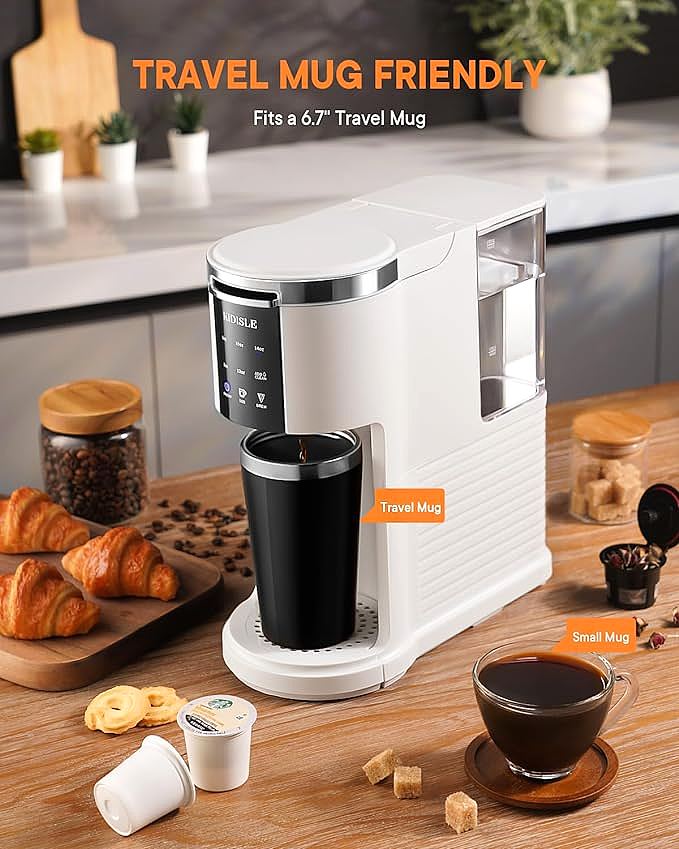
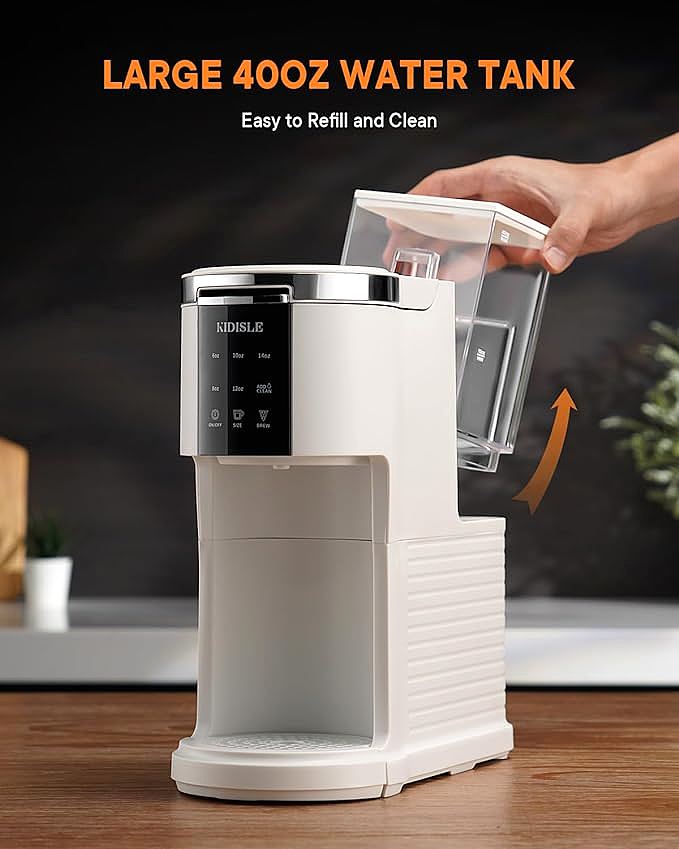
* The 5-Inch Rule: The KIDISLE CM9429D-UL is notably narrow (4.93 inches). This specific dimension is significant. It allows the machine to fit in the “dead space” between a refrigerator and a wall, or between a microwave and a knife block.
* Visual Quietness: The minimalist aesthetic—clean lines, lack of excessive buttons, solid colors (White/Red)—contributes to “visual quietness.” In a cluttered kitchen, appliances that blend in rather than shout for attention reduce cognitive load.
The Ritual Space
Psychologically, having a dedicated “coffee corner,” no matter how small, anchors the morning routine. It provides a sense of stability. The adaptability of the machine supports this ritual for everyone in the household.
* The pragmatist gets their K-Cup speed.
* The purist gets their fresh ground brew.
* The tea drinker gets their hot water infusion.
This adaptability reduces the need for multiple appliances (a kettle, a brewer, a tea steeper), further decluttering the space. In the philosophy of Essentialism, less is more, but only if the “less” can do “more.”
Conclusion: The Informed Consumer
The narrative of the single-serve coffee maker is often simplified to “press button, get coffee.” But as we have explored, the reality is far richer. It is a story of economic choices, where open architecture saves thousands of dollars. It is a story of ecological responsibility, where reusable filters combat the plastic crisis. And it is a story of design, where compact engineering reclaims our living space.
When we choose a machine like the KIDISLE CM9429D-UL, we are not just buying a heat pump and a nozzle. We are buying a tool that allows us to navigate these complex systems. We gain the power to choose our costs, our environmental impact, and our coffee quality.
In an age of endless consumption, the most radical act is to consume with intent. Understanding the economics and ecology of your morning cup is the first step toward that intentionality. Whether you are brewing a quick pod before a commute or carefully measuring grounds for a Sunday morning ritual, the science and the strategy are now in your hands.