
The Geometry of Precision: Engineering Analysis of the DEWALT DWE7491RS Rack & Pinion System
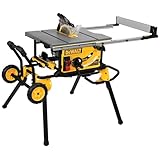
In the hierarchy of woodworking machinery, the table saw is the anchor. For decades, the trade-off was absolute: you could have precision (a heavy, cast-iron cabinet saw) or you could have portability (a lightweight, often inaccurate jobsite saw). The gap between these two worlds has frustrated contractors and mobile craftsmen who demand “shop-quality” cuts in a muddy driveway.
The DEWALT DWE7491RS is significant not just because it is a best-seller, but because it engineers a solution to the most persistent problem in portable sawing: Fence Deflection. By replacing friction-based locking mechanisms with a Rack and Pinion gear system, it introduces a level of geometric certainty previously reserved for heavy industrial machinery. To understand why this matters, we must dissect the mechanics of the cut.

The Mechanics of Alignment: Rack and Pinion vs. Friction
The primary source of error in ripping lumber is a fence that is not perfectly parallel to the blade. Traditional portable saws use a friction lock—you slide the fence and clamp it down. If you push harder on one end, it skews. A skewed fence causes binding, burning, and dangerous kickback.
DEWALT’s engineering answer is the Rack and Pinion Telescoping Fence System.
* The Rack: A toothed track running along both the front and rear rails of the saw table.
* The Pinion: Gears connected by a rod that engage these tracks simultaneously.
The Geometric Advantage
When you turn the adjustment knob, the front and rear of the fence move in perfect lockstep. It is physically impossible for one end to move without the other. This mechanical synchronization ensures that the fence remains parallel to the blade at all times, whether you are cutting at 1 inch or extending it to its maximum capacity. It transforms the setup process from a “measure-tap-measure” ritual into a fluid, trustworthy dial adjustment.
Capacity Physics: The 32-1/2 Inch Threshold
“Rip Capacity” is often just a spec sheet number, but physically, it dictates the structural utility of the machine. The DWE7491RS offers 32-1/2 inches to the right of the blade.
Why this specific number? It is engineered to accommodate standard building materials. A standard sheet of plywood is 48 inches wide. To cut it in half (24 inches), or to rip wider panels for cabinetry, you need reach.
* Cantilevered Stability: Extending the fence this far out places the workpiece center of gravity off the main table. The engineering challenge is supporting this weight without the fence rails bending. The telescoping rails are designed with rigid box-section aluminum to resist torque, ensuring that the “32-inch cut” is as accurate as the “2-inch cut.”

Torque and RPM: The 15-Amp Universal Motor
Unlike the induction motors found in stationary saws (which are quiet but heavy), jobsite saws use Universal Motors.
* High RPM: The DWE7491RS spins at 4800 RPM. This high speed compensates for the lower mass of the motor, allowing for cleaner cuts with less tear-out on the material surface.
* Torque Management: The 15-Amp motor is tuned for high torque at startup to overcome the inertia of the blade and the initial resistance of the wood.
* Thermal Limits: Universal motors are air-cooled and can heat up under continuous heavy load (like ripping thick oak). The design includes directed airflow to cool the armature, a critical feature for longevity in a professional environment. Users should note that unlike induction motors, these have carbon brushes that are wear items and will eventually need replacement—a small price for the power-to-weight ratio that makes portability possible.
Safety Dynamics: Riving Knife and Anti-Kickback
The most dangerous event in table saw operation is Kickback—when the workpiece binds between the fence and the rear of the blade, being launched back at the operator.
The DWE7491RS integrates a Riving Knife that rises and falls with the blade. Unlike old-school splitters, the riving knife maintains a constant distance from the teeth.
* Physics of Separation: By keeping the kerf (the cut slot) open behind the blade, the riving knife prevents the wood from pinching the rising teeth of the blade. This simple metal plate effectively neutralizes the primary mechanical cause of kickback.
* Modular Guarding: The “Site-Pro” modular guarding system allows for tool-free adjustments. This encourages safety compliance because removing and reinstalling the guard is not a chore.

Ergonomics of Mobility: The Rolling Stand
A 90-pound saw is portable only if the physics of moving it are managed. The rolling stand uses leverage and gravity to assist the user.
The splayed leg design provides a wide footprint for stability during use (resisting tipping when feeding long boards), while the large wheels act as a fulcrum for easy transport over jobsite debris. It turns a two-man lift into a one-man roll.
Conclusion: The Benchmark of Mobile Accuracy
The DEWALT DWE7491RS is successful not because of its yellow paint, but because it respects the geometry of woodworking. By mechanically guaranteeing the alignment of the fence through a rack and pinion system, it solves the single biggest variable in cutting accuracy.
For the contractor or woodworker who cannot be tethered to a workshop, this machine offers a rare compromise: the mobility of a hand tool with the geometric precision of a stationary machine. It is an engineering validation that you can indeed take “square and true” with you on the road.