
Beyond the Wireless Hype: Engineering Reliable Access Control for Multi-Tenant Dwellings
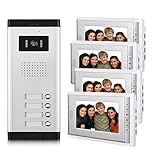
In the age of smart homes, the instinct is often to “cut the cord.” We are surrounded by devices that promise effortless Wi-Fi connectivity and battery power. However, when it comes to the structural security of multi-tenant buildings—duplexes, quadplexes, or small apartment complexes—wireless convenience often collides with the hard physics of building materials and signal congestion.
For property owners and facility managers, the “buzz” at the door is not just a sound; it is a critical checkpoint. It represents the intersection of tenant privacy, property security, and logistical efficiency. While consumer-grade wireless doorbells dominate the single-family market, they frequently falter in shared housing environments.
This brings us to the enduring relevance of hardwired video intercom architectures. Systems designed specifically for multi-household applications, such as the AMOCAM V70C-520-4, serve as excellent case studies in why dedicated infrastructure often outperforms wireless convenience in high-density living spaces. By dissecting such systems, we can understand the engineering principles that ensure reliability where it matters most.

The Physics of Connection: Signal Integrity in Concrete Jungles
The primary challenge in apartment security is latency and interference. In a building with four or more households, you likely have dozens of Wi-Fi networks competing for bandwidth, penetrating through thick firewalls, concrete floors, and steel reinforcements. A wireless video packet trying to traverse this obstacle course often results in lag, frozen frames, or completely dropped connections.
The Hardwired Advantage
Dedicated wired systems utilize a topology known as point-to-point transmission.
* The Highway: By using a 4-core or 5-core cable directly connecting the outdoor station to each indoor monitor, the system creates a private “data highway.”
* Zero Latency: Unlike IP-based cameras that must compress video, send it to a router (and often a cloud server), and then back to a phone, analog wired connections transmit visual data at the speed of electricity. When a visitor presses the button, the monitor lights up instantly.
* Interference Immunity: A shielded wire is impervious to the RF (Radio Frequency) noise generated by microwaves, routers, or baby monitors.
This architectural decision prioritizes reliability over ease of installation. Yes, running wires requires labor, but once installed, the “uptime” is virtually 100%.
Analog Imaging in a Digital World: Decoding TVL
In an era of 4K screens, seeing a specification like “700 TVL” (TV Lines) on a device like the AMOCAM outdoor unit can seem anachronistic. However, in the context of closed-circuit security, analog resolution holds specific value.
TVL refers to the horizontal resolving power of the image. Unlike digital pixels, which are discrete squares, analog video is a continuous waveform. A 700 TVL camera, powered by a CMOS sensor, offers a balance that is optimized for the small 7-inch LCD screens found in these units.
The Night Vision Equation
Security threats do not adhere to business hours. The ability to see in total darkness is non-negotiable. This is achieved through Active Infrared (IR) Illumination.
[Image of the electromagnetic spectrum showing IR range]
The outdoor unit is equipped with IR LEDs that emit light at a wavelength invisible to the human eye (typically 850nm) but visible to the CMOS sensor. When the ambient light sensor detects darkness, it switches the camera to monochrome mode and activates these LEDs. This allows residents to clearly identify facial features or uniforms up to 1.5 meters away in pitch blackness—a capability that passive peepholes cannot match.

The Logic of Control: Centralized Access Management
Perhaps the most critical distinction between a “video doorbell” and an “intercom system” is the ability to physically control the door. This is where the system becomes part of the building’s nervous system.
The Signaling Topology
In systems like the V70C, the indoor monitor acts as a remote switch. When a resident presses “Unlock,” they are not sending a digital code to the cloud; they are closing a circuit.
* The Command: The monitor sends a signal to the outdoor environment.
* The Execution: This signal triggers a specialized Power Supply Control (often separate from the intercom’s power).
* The Mechanism: This controller then sends a 12V DC jolt to an Electric Strike or cuts power to a Magnetic Lock, physically releasing the door.
This separation of duties is a crucial safety feature. It means the heavy lifting (powering the lock) is handled by a dedicated circuit, preventing voltage drops that could occur if the monitor tried to power the lock over a long distance wire. For landlords, this means providing tenants with the power to vet visitors and grant access without leaving their unit, significantly elevating the property’s value and safety profile.
Durability and Environmental Hardening
Consumer electronics are often designed for “curb appeal,” using glossy plastics. Infrastructure equipment must be designed for “curb abuse.”
The outdoor station is the vulnerable point of the entire system. It faces rain, UV radiation, and potentially vandalism. The use of Aluminum Alloy casing, as seen in the AMOCAM unit, is a material science decision. Aluminum forms a natural oxide layer that resists corrosion, and its structural rigidity protects the delicate lens and sensor assembly from impact.
Furthermore, the IP65 rating (Ingress Protection) indicates the unit’s ability to withstand dust and low-pressure water jets. However, experienced installers know that an IP rating is only as good as the installation. Using rain shields and ensuring proper silicone sealing around the back box are “best practices” that prevent moisture wicking—the silent killer of outdoor electronics.

Conclusion: Investing in Infrastructure
For multi-tenant buildings, security is not a gadget; it is infrastructure. While wireless systems offer a quick fix, they often introduce a maintenance burden of battery changes and Wi-Fi troubleshooting.
Hardwired video intercom systems represent a return to first principles: solid connections, dedicated power, and physical durability. They transform the entryway from a passive threshold into a managed access point. By understanding the underlying mechanics—from analog signal transmission to electronic lock integration—property owners can make informed decisions that ensure safety and stability for all residents, proving that sometimes, the best way forward is a wire.