
The Physics of Enclosure: Odor Control, Spatial Dynamics, and the Engineering of the Sealed Environment
In the domestic coexistence between humans and felines, the litter box represents a zone of olfactory conflict. Cats, by their biological nature, produce waste rich in ammonia and thiols—compounds evolved to mark territory and signal presence. Humans, by contrast, strive for sterile, odorless living spaces. Bridging this gap requires more than just scented litter; it requires architectural engineering.
The evolution of the automatic litter box has bifurcated into two dominant philosophies: the Open-Plan (tray style) and the Enclosed System (globe/pod style). While open designs prioritize accessibility, enclosed systems prioritize Containment. They treat the litter box not as a pan, but as a bio-hazard containment vessel.
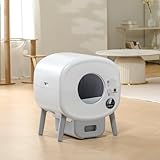
The VEVOR CATBOX-NEO-B is a quintessential example of this enclosed philosophy. It utilizes a Sealed Body Design and a 76L Internal Volume to manage the physics of gas diffusion. This article deconstructs the science of the enclosed box. We will explore Fick’s Laws of Diffusion, the fluid dynamics of Stagnation Zones, and why a physical barrier remains the most effective tool in the war against odor.
The Physics of Diffusion: Why Odors Travel
To understand how an enclosed box works, we must first understand how smell travels. Odor is matter—volatile organic compounds (VOCs) moving through the air.
* Concentration Gradients: According to Fick’s First Law of Diffusion, particles move from an area of high concentration (the poop) to an area of low concentration (your living room). The rate of this movement is proportional to the concentration gradient.
* Air Currents: In an open tray, ambient air currents (HVAC, drafts, walking by) constantly sweep away the “boundary layer” of odor just above the litter, encouraging more VOCs to evaporate and spread. This is Convective Mass Transfer.
The Enclosure as a Stagnation Zone
An enclosed litter box, like the VEVOR CATBOX-NEO-B, acts as a Stagnation Chamber.
* Reducing Airflow: By enclosing the waste source on all sides except a small entry, the design eliminates cross-drafts. The air inside the globe becomes relatively static.
* Saturation Equilibrium: As VOCs evaporate into this small, enclosed volume, the air inside quickly becomes saturated. Once the air immediately above the waste is saturated, the rate of evaporation slows down significantly (dynamic equilibrium).
* The Airlock Effect: The only path for odor to escape is the entry port. Because the air inside is stagnant, odor must exit primarily via slow diffusion rather than rapid convection. This drastically reduces the “Odor Plume” that reaches the human nose.
Structural Sealing: The Engineering of the Waste Bin
The primary source of odor in an automatic box is not the fresh deposit, but the accumulated waste in the storage bin.
* The “Chimney Effect”: In poorly designed robots, the waste drawer is connected to the main globe by an open port. As waste decomposes, it generates heat and gas, which rises back up into the globe and out into the room.
The Sealed Body Design
The VEVOR CATBOX-NEO-B emphasizes a “Sealed Body Design that minimizes gaps.”
* Gasket Engineering: This involves using flexible seals (silicone or rubber) at the interface between the rotating drum and the waste bin.
* The Gravity Flap: Typically, a weighted flap covers the waste port. It opens only when the drum rotates to dump waste and snaps shut immediately after. This mechanical seal acts as a check valve, trapping the concentrated ammonia gas inside the 13L Waste Bin.
* Negative Pressure: Some advanced systems (and potentially future iterations) use weak fans to create negative pressure in the waste bin, pulling air in from the room through a carbon filter, ensuring zero leakage. Even without a fan, a tight mechanical seal is 90% of the battle.

The image above highlights the waste bin. Notice the enclosed nature. By isolating the accumulated waste (up to 15 days’ worth) from the ambient environment, the system effectively “quarantines” the smell.
Volumetric Buffering: The 76L Advantage
Space is not just for comfort; it is a variable in the odor equation. The VEVOR boasts a 76L Internal Capacity.
* Dilution Volume: A larger internal air volume allows for the initial dilution of fresh odors. When a cat defecates, the immediate burst of smell is diluted into 76 liters of air, rather than a cramped 40 liters. This lower initial concentration reduces the intensity of the smell that might drift out of the entrance.
* Thermal Buffering: A larger volume of air is more resistant to rapid temperature changes. Stable temperatures reduce the volatility of some odor compounds.
The Psychology of the Enclosure: The Denning Instinct
While we focus on physics, we must not ignore the biological user. Why do cats tolerate (and often prefer) these enclosed pods?
* The Denning Animal: Evolutionarily, cats are both predators and prey. When vulnerable (sleeping, eliminating), they seek Concealment. A wild cat seeks a cave, a hollow log, or dense brush.
* The Privacy Paradox: While open sightlines are important (to see threats), cover is equally vital. An enclosed box provides protection from three sides and above. For a nervous cat, this “defensible space” reduces cortisol levels.
However, the enclosure must not feel like a trap.
* The Entrance Dimension: The entry must be large enough to allow easy ingress/egress.
* Internal Height: The 76L volume ensures the cat doesn’t feel the ceiling pressing down, which can trigger claustrophobia.

The design shown here balances the need for containment with the need for accessibility. The “pod” shape mimics a natural den, appealing to the cat’s instinctual desire for a hidden latrine.
Deodorization Technology: Active vs. Passive
Beyond physical containment, the VEVOR integrates an “Odor Neutralizing Compartment.”
* Passive Adsorption: This usually involves Activated Carbon. Carbon works by Adsorption (not absorption). The immense surface area of the carbon pores traps VOC molecules via Van der Waals forces.
* Placement Physics: For this to work, the compartment must be placed in the airflow path. Placing it near the waste bin vents ensures that any gas escaping the seal must pass through the carbon gauntlet.
Some systems upgrade this to Active Deodorization (Ozone or Ionization), but passive carbon remains the safest and most reliable method, as it adds no chemical byproducts to the air.
Conclusion: The Sanctuary of Hygiene
The VEVOR CATBOX-NEO-B represents the triumph of “Containment Engineering.” It acknowledges that while we cannot stop biology (cats poop), we can use physics to manage the consequences.
By creating a Stagnation Zone to stop diffusion, employing Mechanical Seals to block the chimney effect, and utilizing Volumetric Dilution to buffer intensity, it transforms the litter box from a source of pollution into a sealed sanitary node.
For the modern home, this is critical infrastructure. It allows the litter box to exist in shared spaces—living rooms, bathrooms—without dominating the olfactory landscape. It is a machine that respects the nose of the human and the instincts of the cat, finding harmony in the physics of an enclosed space.