
The Physics of Invisibility: How Radar Technology is Redefining the Doctrine of Perimeter Security
In the historical evolution of defensive fortifications, the primary objective has always been a duality of purpose: to see without being seen. From the narrow arrow slits of medieval castles to the camouflage netting of modern observation posts, the tactical advantage invariably belongs to the side that possesses superior situational awareness while maintaining a low signature. For decades, the residential and commercial security market has been dominated by a paradox. We install bright floodlights, conspicuous cameras, and visible motion sensors that scream, “You are being watched.” While this overt approach serves as a deterrent, it also provides adversaries with a roadmap of the system’s blind spots. It tells an intruder exactly where to walk to avoid detection.
However, a quiet revolution is currently reshaping the landscape of perimeter security. It is a shift driven not by higher resolution cameras or brighter lights, but by the democratization of a technology once reserved for military and aviation applications: Radio Detection and Ranging, or Radar. As millimeter-wave technology migrates from the battlefield and autonomous vehicle sectors into consumer hands, it is enabling a new doctrine of defense—the Invisible Perimeter. This paradigm shift allows homeowners, property managers, and outdoor enthusiasts to monitor spaces through solid obstacles, creating detection zones that are impossible to visually identify and, therefore, impossible to evade.
The implications of this shift extend far beyond simple gadgetry. It represents a fundamental change in how we conceive of boundaries. A boundary is no longer just a physical fence or a line of sight; it is a volumetric zone of electromagnetic sensitivity that exists invisibly within the environment. Understanding this transition requires us to delve into the physics of sensing, the limitations of traditional optical systems, and the strategic advantages of active interrogation versus passive observation.
The Evolution of Sensing: Breaking the Line-of-Sight Tyranny
To truly appreciate the magnitude of the radar revolution, we must first examine the incumbents it is beginning to displace. For the past forty years, the standard for motion detection has been the Passive Infrared (PIR) sensor. Understanding the mechanics of PIR is essential to understanding why radar represents such a significant leap forward.
The Limitations of Passive Infrared (PIR) Technology
PIR sensors work on a principle of thermal differential. They do not send out signals; they merely “listen” for changes in infrared radiation. Every object with a temperature above absolute zero emits infrared radiation. A PIR sensor detects the background temperature of a room or yard—say, a wall or a tree—and looks for a rapid change caused by a warm body moving across its field of view. The sensor is essentially a thermal camera with only one pixel of resolution.
While cost-effective and energy-efficient, PIR technology suffers from inherent physical limitations that define its operational ceiling. First and foremost is the “Line-of-Sight” (LOS) requirement. Infrared radiation behaves much like visible light; it cannot pass through opaque objects. If you place a PIR sensor behind a wooden fence, a glass window, or even a dense shrub, it becomes blind. This forces the installation of sensors in exposed, visible locations, making them vulnerable to tampering or avoidance.
Secondly, PIR sensors are heavily influenced by environmental thermodynamics. In high-temperature environments—such as a driveway in Arizona on a summer afternoon—the background temperature may approach the body temperature of a human (98.6°F / 37°C). When the background and the target are thermally identical, the contrast disappears, and the sensor fails to detect the intruder. Conversely, rapid environmental changes, such as a cloud passing over the sun or a warm wind hitting a cold surface, can trigger false alarms. This reliance on thermal contrast makes PIR inherently unstable in uncontrolled outdoor environments.
The Active Interrogation of Radar
Radar operates on a fundamentally different principle: Active Interrogation. Unlike PIR, which passively waits for energy to reach it, a radar system actively emits electromagnetic waves—typically in the microwave or millimeter-wave spectrum—and analyzes the echoes that return. This is the difference between listening for a footstep (passive) and shining a flashlight (active), except the “flashlight” in this case shines through solid objects.
When a radar system transmits a radio wave, it travels outward until it hits an object. Some of that energy is reflected back to the source. By analyzing the time delay, frequency shift, and amplitude of this return signal, the system can determine not just the presence of an object, but its distance, speed, and even direction of travel.
This active nature liberates radar from the thermal constraints of PIR. A radar sensor does not care if it is 100 degrees or -20 degrees outside; radio waves behave consistently regardless of ambient temperature. It does not rely on the target being warmer than the background; it relies on the target having a different dielectric constant or physical cross-section. This consistency is crucial for high-security applications where “maybe” is not an acceptable operational status.
The Doppler Effect and Frequency Modulated Continuous Wave (FMCW)
The core mechanism driving consumer radar security is often based on the Doppler Effect. We experience the Doppler Effect audibly when an ambulance passes us: the siren’s pitch is higher as it approaches and lower as it recedes. Radar applies this to radio waves. If an object is stationary, the reflected wave returns at the same frequency it was sent. If the object is moving toward the sensor, the reflected waves are compressed, increasing the frequency. If moving away, they are stretched, decreasing the frequency.
Modern systems often utilize advanced variations like Frequency Modulated Continuous Wave (FMCW). Unlike simple Doppler radar which detects motion speed, FMCW varies the frequency of the transmitted signal over time. This allows the system to calculate the precise distance to the target by measuring the frequency difference between the transmitted signal and the received echo at any given instant.
This ability to measure distance is a game-changer. A PIR sensor only knows “something moved.” It struggles to distinguish between a cat 5 feet away and a person 30 feet away, as both might occupy the same angular portion of its view. Radar, however, can differentiate based on range. It can be programmed to ignore movement within 10 feet (e.g., a swinging tree branch) and only alert on movement between 20 and 50 feet. This “Range Gating” capability allows for a level of precision that passive systems simply cannot match, dramatically reducing the false alarm rate that plagues traditional outdoor security.
The Science of Penetration: Seeing Through the Veil
The most transformative characteristic of radar in a security context is its penetrability. This is where physics translates directly into tactical advantage. The ability of an electromagnetic wave to pass through a material depends on the wave’s frequency and the material’s dielectric properties.
Interaction with Matter
Visible light, with its extremely short wavelengths (400-700 nanometers), interacts strongly with most solids, being either absorbed or reflected. Millimeter-wave radar, operating in frequencies such as 24GHz (wavelength approx. 12.5mm), sits in a “Goldilocks zone” of the electromagnetic spectrum. Its wavelength is long enough to pass relatively unhindered through electrically non-conductive (dielectric) materials, yet short enough to reflect effectively off of water-rich bodies like humans and animals.
- Wood and Drywall: Common building materials like plywood, siding, and gypsum board are largely transparent to radar. The waves pass through them with minimal attenuation (signal loss). This means a sensor can be mounted inside a garage, looking out through the wooden wall, completely hidden from the exterior.
- Glass and Plastic: These materials are also highly transparent to radar frequencies. A sensor can be placed on a dashboard inside a locked vehicle, monitoring the exterior environment through the windshield.
- Ceramics and Masonry: Brick and concrete are denser and can attenuate the signal more significantly, often reducing range, but they do not block it entirely unless they are extremely thick or reinforced with metal mesh.
- Metal and Water: Metal is a complete reflector. Radar cannot see through a metal shed or a tin roof; the signal will bounce off. Similarly, the human body, being composed largely of saline water, is an excellent reflector of radar energy. This is precisely why radar is so effective at detecting people—we light up like beacons in the radio spectrum, even if we are hiding behind a bush.
The Tactical Concept of the “Ghost Node”
This penetrability allows for the creation of “Ghost Nodes”—sensor emplacements that do not exist to the naked eye. In a traditional security audit, a criminal might scan a property for cameras and PIR sensors. They map the “cones of vision” and plan a route through the shadows.
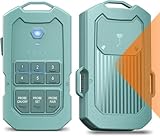
With radar, this visual logic fails. A harmless-looking plastic birdhouse on a tree could contain a radar module. A pile of empty cardboard boxes in a warehouse could house a sensor monitoring the main aisle. The siding of the house itself could be the lens of the security system. The LETWESAF Radar Security System exemplifies this capability. Designed with a focus on penetrability, it can monitor a 45-foot zone while completely concealed behind non-metal barriers.

By leveraging devices like the LETWESAF system, security designers can implement a “deny and deceive” strategy. The intruder, seeing no visible sensors, assumes the path is clear. They proceed into the detection zone, triggering the alert. Because they cannot see the sensor, they cannot disable it. They cannot spray paint it, smash it, or cut its wires, because they don’t know where it is. This informational asymmetry shifts the balance of power back to the defender.
Strategic Deployment: The Layered Invisible Perimeter
Implementing radar technology requires a rethink of deployment strategies. It is not enough to simply swap a PIR sensor for a radar unit; one must design the perimeter based on volumetric zones rather than lines of sight. This involves a concentric circle approach to property defense.
Zone 1: The Outer Warning Ring (The Psychological Zone)
The outermost layer of defense is often not about apprehension, but about awareness. In large properties, farms, or campsites, this zone might be 50 to 100 feet from the main structure. The goal here is early warning.
Radar excels in this zone due to its range and resistance to environmental noise. Traditional PIR sensors are notoriously unreliable at long ranges outdoors; wind blowing through grass or sunlight heating up the ground can cause incessant false alarms. Radar, utilizing Doppler processing, can filter out the chaotic, non-linear motion of wind-blown vegetation and focus on the linear, vector-based motion of a walking human or a rolling vehicle.
For the LETWESAF system, with its 1/2 mile wireless transmission range back to the receiver, this outer ring can be established far from the main dwelling. A sensor placed at the driveway entrance, hidden inside a PVC pipe or a plastic utility box, serves as a silent announcer. It provides the occupants with the most valuable asset in a security scenario: time. Time to check cameras, time to lock doors, or time to turn on exterior lights.
Zone 2: The Denial Zone (The Hard Perimeter)
The second layer is the immediate perimeter of the asset—the walls of the house, the RV, or the tent. Here, the precision of radar is paramount. This is where “Range Gating” becomes critical. You might want to detect someone peering into a window (3 feet away) but ignore the sidewalk traffic (15 feet away).
In this zone, the penetrability feature is used for equipment protection. For an RV dweller, the risk of theft is high. Solar panels, generators, and bicycles are often left outside. A visible sensor invites theft of the sensor itself. A radar unit placed inside the RV, looking out, covers these assets without exposing the security hardware. The system creates a bubble of protection that extends through the vehicle’s walls (assuming they are fiberglass/wood) or windows.
Zone 3: The Interior Trap (The Verification Zone)
While often overlooked, radar has applications inside structures as well. Because it doesn’t rely on light, it functions perfectly in pitch-black basements or attics. Furthermore, its ability to detect “micro-motions”—such as the breathing of a person hiding in a room—adds a layer of detection that PIR cannot achieve. While current consumer perimeter systems like the LETWESAF are tuned for gross motor movement (walking/driving) to cover large areas, the underlying technology is capable of this vital sign detection, a feature likely to trickle down into future firmware or product iterations.
The Psychological Dimension of Invisible Security
Security is as much a psychological game as it is a technological one. Visible security (cameras, lights, signs) relies on the principle of Deterrence. It says, “The cost of attacking this target is high.” However, deterrence only works if the attacker acts rationally and fears the consequences.
Invisible security relies on the principle of Uncertainty. When an attacker triggers an alarm but sees no sensor, they experience a cognitive dissonance. They cannot neutralize the threat because the threat is omnipresent yet intangible. This creates a heightened state of paranoia. Did they trip a wire? Is someone watching them from the woods? Is it a pressure sensor?
This uncertainty disrupts the attacker’s OODA Loop (Observe, Orient, Decide, Act). They fail to Observe the sensor, which prevents them from Orienting themselves to the threat. They cannot Decide on a safe approach path, leading to hesitation or retreat. In a camping or survival scenario, where law enforcement response might be hours away, this psychological disruption is a critical defensive tool. It turns the environment itself into a hostile observer.
Future Horizons: The Convergence of AI and Radar
As we look toward the next 3 to 5 years, the trajectory of consumer radar is clear: it will converge with Artificial Intelligence. Currently, systems like the LETWESAF use signal processing algorithms to filter out rain and small animals based on signal return size and speed. The next generation will introduce “Micro-Doppler Signature Classification.”
Just as a person has a unique gait, different moving objects produce unique micro-Doppler signatures. The swinging of human arms and legs creates a specific modulation pattern distinct from the rotating wheels of a car or the bounding of a deer. Machine learning models, trained on these radar signatures, will allow sensors to classify targets with near-perfect accuracy. A system will not just beep; it will announce, “Human approaching” vs. “Vehicle approaching” vs. “Dog in the yard.”
Furthermore, the integration of radar with camera systems (Sensor Fusion) will become standard. Radar will serve as the long-range, all-weather trigger that wakes up a high-resolution camera. The radar tells the camera exactly where to focus and zoom, solving the power-consumption issue of always-on video analytics.
Conclusion: Embracing the Electromagnetic Shield
The shift from PIR to Radar is not merely a specification upgrade; it is a transition from an analog, line-of-sight world to a digital, volumetric one. It empowers users to secure their environments in ways that were previously physically impossible. By leveraging the penetrability and precision of systems like the LETWESAF, we can construct perimeters that are robust, discreet, and tactically superior.
In an era where personal security is increasingly the responsibility of the individual—whether on a remote homestead, a suburban property, or a nomadic campsite—understanding and utilizing these advanced sensing technologies is no longer a luxury. It is a fundamental component of modern resilience. We are moving away from the era of the “Security Guard” (visible, fallible) to the era of the “Invisible Shield,” where the air itself stands watch.