
The Engineering of Student-Proofing: Why “Always-On” Protection Matters
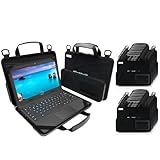
In the ecosystem of educational technology, the Chromebook has become the de facto standard. It is affordable, versatile, and—unfortunately—fragile. For school districts managing thousands of devices, or parents managing just one, the “break-fix” cycle is a relentless budget drain. A cracked screen isn’t just a repair cost; it’s lost learning time.
The solution isn’t to buy cheaper devices; it’s to invest in smarter physics. Protection is often an afterthought, relegated to a flimsy neoprene sleeve bought at the checkout counter. But true device longevity requires an engineering approach. By dissecting the UZBL 13-14 Inch Always-On Case, we can understand the three critical principles of “Student-Proofing”: Impact Dispersion, Transitional Security, and Mechanical Integrity.

Principle 1: Material Science (Why “Squishy” Isn’t Enough)
Not all foams are created equal. The standard cheap laptop sleeve uses open-cell polyurethane foam—essentially the same material as a kitchen sponge. While soft to the touch, it “bottoms out” easily under impact, transferring the force directly to the laptop chassis.
The UZBL case utilizes High-Density EVA (Ethylene-Vinyl Acetate). This is a closed-cell polymer, sharing more DNA with high-performance running shoe midsoles than with upholstery.
* The Physics of Dispersion: EVA is composed of millions of microscopic gas bubbles trapped within a polymer matrix. When dropped, these bubbles compress, converting the kinetic energy of the fall into heat and dispersing it laterally across the case surface, rather than vertically into the Chromebook’s motherboard or screen.
* The “Crush” Factor: Unlike soft sleeves, the rigid EVA shell provides structural resistance against crush loads. This is critical for students who shove their Chromebooks into overstuffed backpacks filled with heavy textbooks. The case acts as an exoskeleton, preventing pressure cracks on the screen.

Principle 2: Solving “Transitional Vulnerability” (The Always-On Logic)
In risk analysis, the most dangerous moment for any secure asset is during transport or transition. For a laptop, the moment of highest risk is when it is removed from its protective sleeve to be used. A sleeve protects a device only when it is not in use.
The “Always-On” design philosophy addresses this flaw. It is a work-in solution.
* Continuous Engagement: The UZBL case features specialized screen corner grips and base straps. These utilize friction and tension to keep the case securely attached to the device even while open.
* The Safety Net: If a student knocks the device off a desk while working (a common classroom scenario), the device is already armored. There is no “naked” interval. This design shifts protection from a passive storage state to an active usage state.
* Universal Compatibility: Designed for the 13-14 inch form factor, this system accommodates various models from HP, Lenovo, Dell, and Acer (up to 13.6 inches in length). This is vital for schools with mixed fleets or parents who upgrade devices every few years—the armor survives the upgrade cycle.

Principle 3: Mechanical Endurance (The YKK Standard)
A chain is only as strong as its weakest link. In protective cases, that link is almost always the zipper. A zipper failure renders the entire case useless, often spilling the device onto the pavement.
This is where component selection becomes a signal of quality. The UZBL case employs YKK zippers, the global benchmark for fastener reliability.
* Cycle Testing: YKK zippers are engineered to withstand thousands of open-close cycles without tooth deformation or slider misalignment.
* Lateral Strength: In a drop scenario, the impact forces the case to expand rapidly. Cheap coil zippers can burst open under this pressure (a “zipper blowout”). YKK fasteners are tested for high lateral strength, ensuring the case stays closed upon impact, keeping the EVA protection where it belongs—around the device.
The Verdict: Protection as an Investment
When we look at the total cost of ownership for a Chromebook, we must factor in the likelihood of repair. A screen replacement can cost 50-70% of the device’s value.
The UZBL Always-On Case is not merely an accessory; it is an insurance policy built from nylon and EVA. By addressing the specific behaviors of students—backpack stuffing, desk drops, and rough handling—it moves beyond “carrying” to true “engineering,” ensuring that technology remains a tool for learning, not a source of expense.