
Symbolism Decoupled: The Socio-Economic Shift Towards Accessible Luxury in Bridal Jewelry
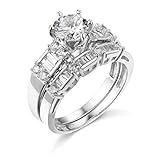
For the better part of a century, the diamond engagement ring has been the ultimate “Veblen good”—a commodity whose demand increases as its price increases, serving primarily as a signal of wealth and status. The marketing machinery of the 20th century successfully conflated the size of the stone with the depth of the commitment, creating a rigid social script: a month’s salary (or two, or three) exchanged for a geological rarity.
However, the tectonic plates of the jewelry market are shifting. Products like the TWJC Wedding Collection 14k Gold and Cubic Zirconia Set are not merely low-cost alternatives; they are artifacts of a profound socio-economic transition. We are witnessing the democratization of luxury and the decoupling of symbolism from scarcity.
This article explores the rising tide of “Accessible Luxury” in the bridal sector. It examines the economic forces, ethical considerations, and psychological shifts driving modern couples to embrace high-quality simulants and engineered materials. In this new paradigm, the value of a ring is defined not by its resale price on the commodities market, but by its aesthetic performance, ethical provenance, and the financial freedom it preserves for the couple’s future.
The Economics of “Real”: Deconstructing the Scarcity Myth
To understand the rise of accessible bridal jewelry, one must first deconstruct the traditional value proposition of the diamond industry. The “value” of a natural diamond is largely artificial, maintained by tightly controlled supply chains and brilliant marketing campaigns (most notably by De Beers).
The Rational Actor and Opportunity Cost
Modern consumers, particularly Millennials and Gen Z, operate with a heightened sense of economic rationality. They came of age during financial crises, student debt bubbles, and housing shortages. For this demographic, the concept of Opportunity Cost is visceral. Spending 5,000 or 10,000 on a piece of jewelry is increasingly viewed as a misallocation of capital. That same capital could fund a down payment on a home, a transformative travel experience, or an investment portfolio.
In this context, a set like the TWJC collection—priced at a fraction of a mined diamond equivalent—represents a rational economic choice. It delivers 99% of the visual utility (the sparkle, the symbol, the gold setting) for 1% of the cost. The “Accessible Luxury” segment is growing because it aligns with a worldview that prioritizes experiences and assets over depreciating status symbols.
The Depreciation Reality
Unlike gold, which is a fungible currency with a spot price, diamonds are notoriously illiquid. A diamond ring loses a significant portion of its value the moment it leaves the store—a phenomenon often compared to driving a new car off the lot.
Gold, however, retains its intrinsic value. The 14k gold in the TWJC set is a store of value. While the craftsmanship commands a premium, the raw material (gold) remains a tradable asset. By choosing a ring where the cost is primarily in the gold rather than the stone, the consumer is making a safer financial bet. They are investing in the metal, which has historical permanence, rather than the “myth” of the gemstone’s resale value.

The Ethics of Synthesis: Lab-Grown as a Moral Choice
Beyond economics, the shift towards simulated stones like Cubic Zirconia (and increasingly, Moissanite and Lab-Grown Diamonds) is driven by Ethical Consumption.
The “Blood Diamond” narrative, despite industry efforts like the Kimberley Process, has left an indelible mark on the collective consciousness. Mining is an extractive industry with significant environmental and human rights footprints. Open-pit mines displace communities, disrupt ecosystems, and consume vast amounts of water and energy.
The Zero-Conflict Guarantee
Synthesized crystals like Cubic Zirconia offer a “clean slate.”
* Environmental Impact: While lab synthesis requires energy, its footprint is localized and generally lower than the massive earth-moving operations required for mining.
* Human Rights: There is no ambiguity about the labor conditions in a high-tech crystal growth facility. It is a manufacturing process, not an extraction process.
For a generation that scrutinizes the supply chain of their coffee and the carbon footprint of their travel, the “Zero-Conflict” guarantee of a lab-grown stone is a powerful selling point. It allows the wearer to display a symbol of love that is untainted by exploitation. The TWJC set, featuring a lab-created CZ, implicitly carries this narrative. It is a product of human ingenuity, not human suffering.
The Psychology of Aesthetics: The “Uncanny Valley” of Jewelry
There is a fascinating psychological dimension to the acceptance of simulated stones. In the past, “fake” jewelry was easily identifiable by its poor quality—cloudy glass, cheap base metals that turned skin green. It looked “cheap.”
Today, however, material science has pushed simulants out of the “cheap” category and into the realm of Hyper-Reality. As discussed in the previous article, high-quality Cubic Zirconia is optically superior to many commercial-grade diamonds in terms of fire and flawlessness.
The Democratization of Beauty
This technological leap has democratized beauty. In the past, only the ultra-wealthy could afford a flawless, colorless, 1.25-carat stone. Today, that aesthetic standard is accessible to almost anyone via materials like CZ.
This shifts the social signal. When “perfect” looking stones are widely available, the ring ceases to be a reliable signal of wealth. Instead, it becomes a signal of Taste and Style. The focus shifts from “How much did he spend?” to “How beautiful is the design?”
The TWJC Wedding Collection leverages this. It pairs the “perfect” stone with 14k Solid Gold, ensuring that the tactile experience and durability match the visual brilliance. It avoids the “costume jewelry” trap by using noble metals, firmly planting itself in the category of “Fine Jewelry” even if the stone is simulated. It allows couples to participate in the traditional aesthetic of the bridal ritual without the traditional financial barrier.
The Rise of the “Starter Ring” and Modular Commitment
Another emerging trend is the concept of the “Starter Ring” or the evolving bridal stack. The idea that one must buy a “forever ring” immediately is fading. Modern relationships often follow different trajectories—cohabitation, shared mortgages, then marriage.
Many couples opt for a high-quality but affordable set like the TWJC collection for the proposal or the early years of marriage, with the explicit intention of “upgrading” or adding to it later.
* Financial Prudence: It allows young couples to prioritize establishing their life together (buying a house, paying off debt) without delaying the engagement.
* Style Evolution: Tastes change. A ring bought at 25 might not suit the wearer at 40. Lower-cost entry points allow for flexibility.
* The Travel Ring: Even among those who own expensive diamond rings, there is a booming market for “Travel Rings”—high-quality duplicates (often CZ and Gold) worn during vacations to avoid the risk of losing or damaging the primary heirloom. The TWJC set is perfectly positioned for this utility—valuable enough to look real and feel substantial, but replaceable if lost.
Conclusion: The New Definition of Heirloom
The TWJC Wedding Collection 14k Gold and CZ Set is a microcosm of a larger industry evolution. It challenges the archaic notion that the durability of a marriage is correlated with the price of the jewelry.
We are moving towards a future where “Luxury” is defined by Freedom—freedom from debt, freedom from ethical compromise, and freedom to define value on one’s own terms. In this new era, a ring engineered from solid gold and perfected crystals is not a compromise; it is a declaration of modern values. It asserts that the promise made is real, even if the stone was born in a crucible rather than a crater. The symbol remains; only the burden has been removed.