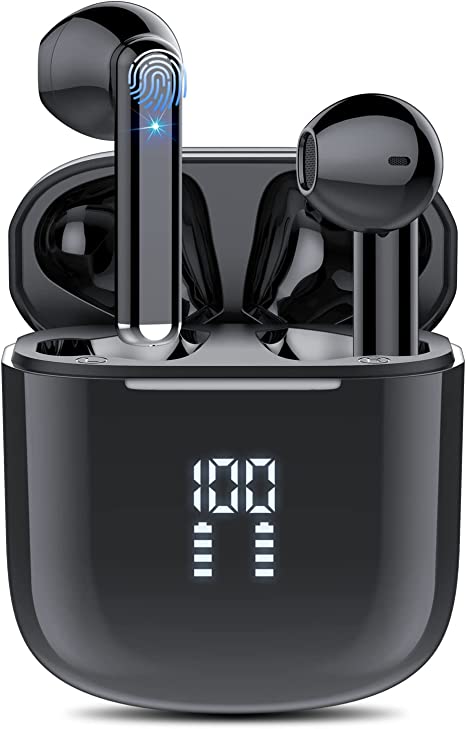
The Unseen Engineering: A Deep Dive into Bluetooth 5.3 and Call Noise Cancellation

In the sprawling, hyper-competitive world of consumer electronics, it’s easy to become numb to specifications. We see “Bluetooth 5.3” or “ENC Noise Cancellation” listed on a $30 pair of wireless earbuds like the OYIB MD058A and simply nod, accepting it as the baseline. But it’s worth pausing to consider the sheer engineering marvel this represents. A decade ago, these features were the stuff of high-end, flagship devices. Today, they are ubiquitous. This isn’t just about Moore’s Law; it’s about the relentless standardization, optimization, and democratization of complex technology. In a global market where, according to market research firm Canalys, true wireless stereo (TWS) shipments are projected to hit 600 million units in a single year, understanding the science packed into these tiny devices is more relevant than ever. This is the story of the unseen engineering that makes your daily audio experience possible, starting with the invisible thread that connects it all: Bluetooth.
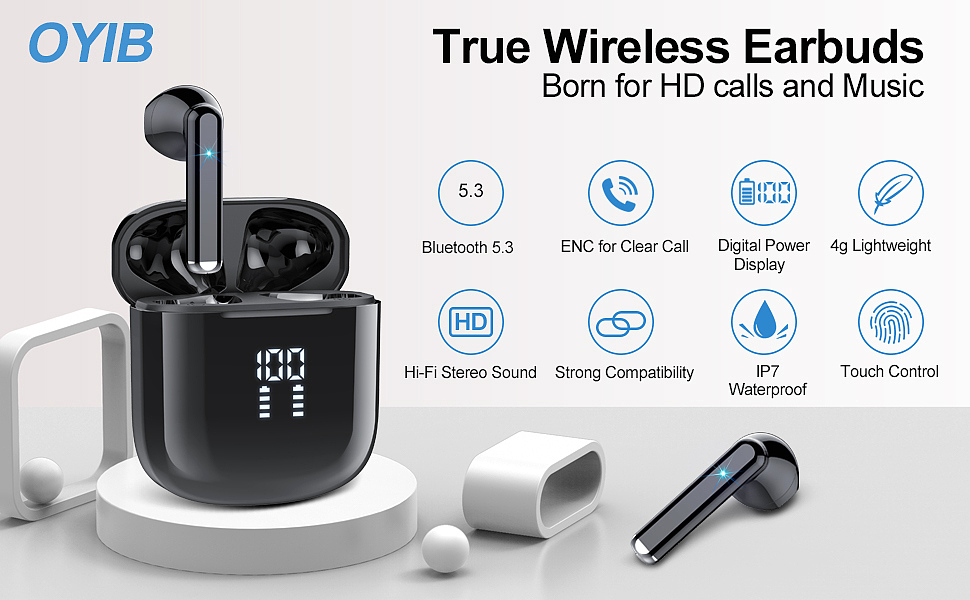
Decoding Bluetooth 5.3: It’s Not About Speed, It’s About Intelligence
For years, the marketing of new Bluetooth versions has revolved around two simple metrics: speed and range. While true, this oversimplification misses the point of modern iterations. The leap to Bluetooth 5.3 is less about raw power and more about sophisticated intelligence—making the wireless connection smarter, more efficient, and vastly more stable, especially in the electromagnetically “noisy” environments we live in today.
The Evolution and the LE Audio Revolution
The real game-changer, closely associated with the Bluetooth 5.x series, is the introduction of LE Audio. This new standard operates on a revolutionary audio codec called the Low Complexity Communication Codec, or LC3. For the end-user, the science translates to a simple, powerful benefit: LC3 can deliver perceived audio quality equal to or better than the older, mandatory SBC codec, but at a significantly lower data rate. According to the Bluetooth Special Interest Group (SIG), the standards body for the technology, LC3 can provide a more robust and higher-quality signal at up to a 50% lower bit rate. This efficiency is profound. It means your earbuds can maintain a high-quality audio stream even when the signal is weak, and crucially, it consumes less power, directly contributing to longer battery life.
The Pillars of Stability: Channel Classification and Connection Subrating
Beyond the codec, Bluetooth 5.3 introduces clever mechanisms for maintaining a rock-solid link.
- Channel Classification Enhancement: Bluetooth operates by rapidly hopping between different frequency channels to avoid interference. Previously, this classification of “good” and “bad” channels was primarily done by the central device (your phone). Now, the peripheral device (your earbuds) can also contribute its own assessment of the channel quality. It’s like giving your GPS two sources of traffic information instead of one, allowing it to plot a much more reliable route for the data packets to travel.
-
Connection Subrating: This allows a device to switch between high-duty and low-duty cycles much faster. Imagine your earbuds are in a low-power state, just waiting for a notification. When one arrives, this feature allows them to “wake up” and switch to a high-bandwidth connection almost instantly, improving responsiveness without constantly draining the battery.
A stable connection, however, is only half the battle. What good is a flawless audio stream if the person on the other end of your call can only hear the city bus roaring past you? This brings us to the second piece of unseen engineering in these earbuds: Environmental Noise Cancellation.
The Art of Being Heard: How ENC Creates a “Vocal Spotlight”
Here lies one of the biggest points of confusion in audio marketing: Environmental Noise Cancellation (ENC) is not Active Noise Cancellation (ANC). They solve two entirely different problems.
- ANC is for the listener. It creates a bubble of silence for you by using microphones to listen to outside noise and generating an inverse sound wave to cancel it out. It’s designed for your immersion.
- ENC is for the person on the other end of the call. It’s a technology designed to isolate your voice from the ambient noise around you, ensuring they hear _you_ clearly, not your environment.
The Science: Microphones, Beamforming, and Digital Magic
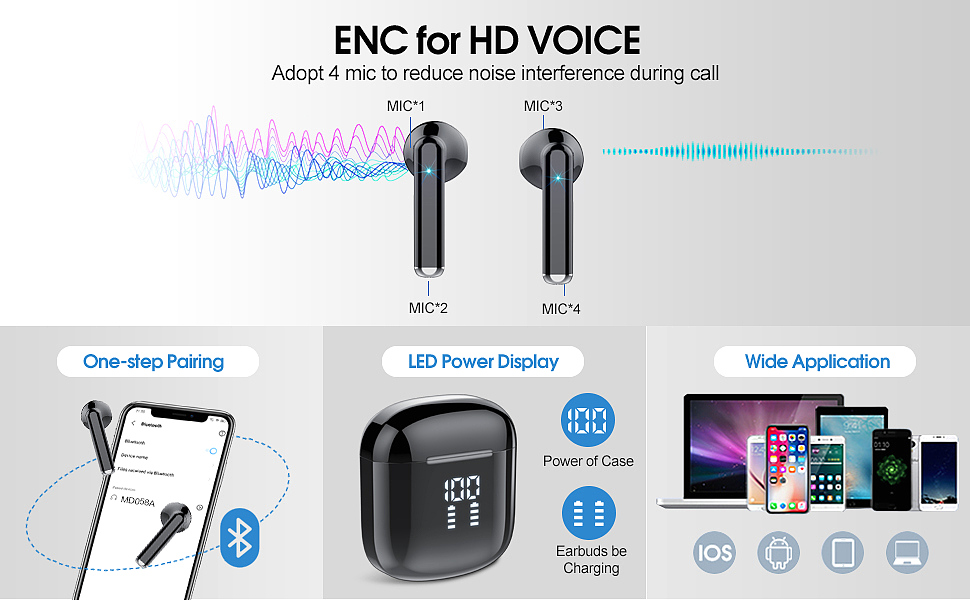
So, how does ENC work? It’s a beautiful application of physics and computation, and the “4-Mic” specification on the OYIB MD058A is the key. The system relies on a technique called beamforming.
Imagine you’re at a loud party, trying to hear a friend speak. Instinctively, you use your two ears and brain to focus on their voice and filter out the surrounding chatter. Beamforming is the digital equivalent of this.
- The Microphone Array: With two microphones on each earbud, the device gets multiple, slightly different recordings of the soundscape. The microphone closest to your mouth will pick up your voice milliseconds sooner and slightly louder than the microphone further away.
-
Digital Signal Processing (DSP): A tiny chip inside the earbud acts as the brain. It analyzes the time and volume differences between the signals received by the microphones. Using complex algorithms based on the principles of wave interference, the DSP can “calculate” the direction your voice is coming from.
-
Creating the Beam: The DSP then digitally amplifies the sound coming from that specific direction (your mouth) while suppressing sounds from all other directions. It effectively creates a focused “beam” or “spotlight” of listening sensitivity pointed directly at your voice. This is why multi-microphone systems, like Qualcomm’s cVc, are so much more effective at call clarification than single-mic setups.
The Inevitable Compromise
This digital wizardry of beamforming sounds impressive, and it is. However, it also explains the crucial limitation and why some users might claim there is “zero noise cancellation.” ENC is not designed to silence the world for you. It is a highly specialized tool for clarifying your transmitted voice. It’s why a $30 pair of earbuds can dramatically improve call quality in a noisy cafe but will do almost nothing to silence the drone of a jet engine on a plane for you, the wearer. That task belongs to the far more complex and power-hungry technology of ANC.
Conclusion: The Quiet Democratization of Clear Sound
The OYIB MD058A earbuds, and hundreds of others like them, are not just disposable gadgets. They are tangible artifacts of technological democratization. The journey of a feature from a research lab, through academic papers from institutions like IEEE, to a proprietary implementation, and finally to a standardized, low-cost System-on-a-Chip (SoC) that can be placed in a sub-$30 device is a quiet triumph of modern engineering. Understanding what Bluetooth 5.3 truly offers—efficiency and intelligence—and how ENC works—a vocal spotlight, not a cone of silence—allows us to be more informed consumers. It empowers us to appreciate the incredible, unseen engineering that, for the price of a few cups of coffee, allows us to be heard clearly in an ever-noisier world.