
The Architecture of Equilibrium: How Silicon Mastered Gravity
The act of standing upright is a deception. It appears static, a state of rest, yet biologically and physically, it is a constant, frantic negotiation with gravity. The human body is essentially an inverted pendulum—a mass perched atop a pivot point—that is inherently unstable. Without continuous, subconscious intervention, we fall. For millions of years, this dynamic balancing act was the exclusive domain of biological organisms equipped with inner ears and complex nervous systems.
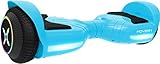
However, the turn of the 21st century witnessed a quiet revolution. We taught silicon to feel gravity. We encoded the instinct of balance into algorithms. The result was a new class of machines: self-balancing personal transporters. While often categorized as toys or simple recreational devices, products like the Hover-1 Rival Electric Hoverboard represent the democratization of advanced robotics. Beneath their molded plastic shells lies a sophisticated synthesis of control theory, solid-state physics, and electromagnetic engineering that mirrors the guidance systems of aerospace vehicles.
To truly understand these devices is to look beyond their recreational utility and appreciate them as triumphs of cybernetic engineering. They are proof that with the right combination of sensors and mathematics, we can create machines that defy the fundamental instability of nature.
The Physics of the Fall: The Inverted Pendulum Problem
In engineering dynamics, the “inverted pendulum” is a classic problem. Imagine balancing a broomstick on the palm of your hand. To keep the stick upright, you must constantly move your hand in the direction the stick starts to fall. If it tips forward, you accelerate your hand forward. If you move fast enough and precisely enough, the base (your hand) gets back under the center of mass (the stick), and equilibrium is restored.
A hoverboard faces the exact same challenge, but with higher stakes. The rider is the broomstick; the wheels are the hand. The system has only one axis of instability: pitch (tilting forward or backward). The machine’s sole mission is to keep the rider’s center of gravity vertically aligned with the wheel axles.
This sounds simple in principle but is excruciatingly difficult in practice because of latency. In the broomstick analogy, if your reaction time is too slow, the stick falls. If your reaction is too jerky, you overcorrect, and the stick flies off in the opposite direction. The machine must react faster than human perception—typically hundreds of times per second—measuring the tilt, calculating the necessary correction, and applying torque to the wheels with near-zero delay.
The Sensorium: Micro-Electro-Mechanical Systems (MEMS)
How does a machine know which way is down? For decades, this required bulky, spinning mechanical gyroscopes, like those found in 20th-century aircraft or submarines. These were heavy, expensive, and fragile. The breakthrough that made the modern hoverboard possible was the miniaturization of these sensors into Micro-Electro-Mechanical Systems (MEMS).
The Silicon Inner Ear: The Gyroscope
Deep within the control board of the Hover-1 Rival sits a MEMS gyroscope. It is a chip no larger than a grain of rice, yet it contains microscopic vibrating structures etched into silicon. When the board tilts—rotates around the wheel axis—these vibrating structures experience a phantom force known as the Coriolis force.
Imagine walking on a spinning merry-go-round from the center to the edge. You feel a sideways push. That is the Coriolis force. In the MEMS chip, as the hoverboard tilts, the vibrating mass is pushed sideways by this force. The chip measures this microscopic displacement electrically. The magnitude of this displacement is directly proportional to the angular velocity—how fast the board is tilting.
This sensor is incredibly sensitive. It doesn’t just tell the computer “we are tilting”; it screams “we are rotating forward at 4.5 degrees per second!” This rate data is crucial for anticipating the fall before it becomes unrecoverable.
The Anchor of Reality: The Accelerometer
The gyroscope has a weakness: it drifts. Over time, small errors add up, and the gyroscope might think “level” is actually a 5-degree tilt. To correct this, the system employs an accelerometer.
While the gyroscope measures rotation, the accelerometer measures linear force. When the hoverboard is stationary, the only force acting on it is gravity, pulling straight down at 9.8 m/s^2. The accelerometer detects this gravity vector. By analyzing the direction of this force relative to the board, the system can calculate the absolute tilt angle relative to the earth.
However, the accelerometer is noisy. Vibrations from the road or sudden movements can confuse it. This is where Sensor Fusion comes in. The control computer combines the smooth, fast data from the gyroscope with the stable, absolute data from the accelerometer using a mathematical filter (often a Kalman Filter or a Complementary Filter). The result is a mathematically pure understanding of the board’s orientation in space.

The Cognitive Loop: PID Control Theory
Once the board knows it is tilting, what does it do? This is the realm of Control Theory, specifically the PID Controller (Proportional-Integral-Derivative). This is the algorithm that translates “tilt” into “motor power.” It is a feedback loop that runs continuously, cycling through three distinct mathematical terms to determine the perfect response.
1. The Proportional (P) Term: The Immediate Reaction
The “P” term looks at the present error. The error is the difference between the desired angle (0 degrees, or flat) and the actual angle (say, 5 degrees forward).
* Logic: “We are leaning forward, so move the wheels forward!”
* Action: The P term multiplies the error by a constant gain. A small lean gets a small push; a big lean gets a big surge of power.
* Flaw: If you rely only on P, the system tends to oscillate. It corrects the lean, but momentum carries it past vertical, and it leans back, leading to a perpetual wobble.
2. The Integral (I) Term: Correcting the Past
The “I” term looks at the accumulated past error. It asks, “Have we been leaning forward for a long time?”
* Scenario: Imagine riding up a slight hill (like the 10-degree incline capability of the Hover-1 Rival). The P term might not provide enough power to overcome gravity, leaving you leaning slightly forward but not moving.
* Action: The I term notices this persistent error. It slowly ramps up the power until the board overcomes the hill and returns to vertical. It ensures precision and eliminates “droop.”
3. The Derivative (D) Term: Predicting the Future
The “D” term is the crystal ball. It looks at the rate of change of the error.
* Logic: “We are returning to vertical very quickly. If we don’t back off now, we will overshoot.”
* Action: The D term acts as a virtual shock absorber. It applies a “braking” force to the control output as the target is approached. This dampens the oscillation caused by the P term, creating that smooth, “gliding” sensation rather than a jerky, robotic shutter.
In the Hover-1 Rival, this PID loop executes hundreds, perhaps thousands, of times per second. It creates a sensation of telepathy: you think about moving forward, you shift your weight infinitesimally, and the algorithm detects the micro-tilt, predicting your intent and moving the wheels to support you.
The Actuation: Electromotive Force and Torque
The command from the PID controller is a digital signal. To move the rider, this must be converted into physical torque. This is achieved through Brushless DC (BLDC) Motors, typically integrated directly into the wheels (hub motors).
Older brushed motors used physical carbon brushes to transfer electricity, creating friction and sparks. BLDC motors use electromagnets on the stator (the stationary part) and permanent magnets on the rotor (the spinning wheel). The controller energizes the electromagnets in a specific sequence, pulling the permanent magnets around.
This “electronic commutation” allows for precise control. The Hover-1 Rival’s dual 110W motors are not just spinning; they are stepping through magnetic fields with extreme precision. They can go from 0 to full torque almost instantly. This responsiveness is non-negotiable for a self-balancing vehicle. If the motors lagged even by a fraction of a second, the “catch” would come too late, and the rider would fall.
The motors also act as generators. When the rider leans back to brake, the motors resist the motion, converting the kinetic energy of the rider back into electrical energy, which is fed back into the battery. This Regenerative Braking not only extends the range (up to 3 miles in this compact format) but also provides a smooth, non-mechanical braking feel.

Safety Engineering: The Legacy of UL2272
No discussion of hoverboard engineering is complete without addressing the safety architecture. The early days of the industry were marred by incidents of thermal runaway—battery fires caused by poor quality control and inadequate battery management systems (BMS). This led to the creation of the UL2272 Standard, a rigorous safety certification for electrical systems in self-balancing scooters.
Safety in a device like the Hover-1 Rival is not just about using good cells; it is about redundancy and monitoring. The Battery Management System is a dedicated computer that watches the Lithium-Ion pack. It monitors:
* Voltage Balance: Ensuring individual cells charge and discharge at the same rate.
* Temperature: Cutting power if the pack gets too hot during aggressive riding or charging.
* Current Draw: Preventing the motors from pulling more amps than the battery can safely deliver (overcurrent protection).
Furthermore, the UL2272 standard mandates mechanical tests—drop tests, crush tests, and vibration tests—to ensure that the internal wiring doesn’t short-circuit after the board hits a curb. The certification mark is effectively a seal of engineering discipline, separating legitimate transport tools from dangerous knock-offs.
Conclusion: The Cybernetic Extension
The hoverboard is a profound example of Cybernetic Extension. It is a tool that integrates so seamlessly with the human feedback loop that it ceases to feel like a vehicle and starts to feel like a body part. The rider does not “steer” with a wheel or a stick; they steer with their intent, their posture, their center of mass.
The engineering principles dissected here—the inverted pendulum physics, the MEMS sensor fusion, the PID control loops, and the electromagnetic actuation—are the same principles driving the development of bipedal humanoid robots and autonomous delivery vehicles. The Hover-1 Rival, in its accessible and compact form, offers a glimpse into a future where machines do not just carry us, but actively collaborate with us to navigate the physical world. It teaches us that stability is not a static property, but an active, dynamic, and computational process.