
Beyond the Decibels: A Homeowner’s Guide to Quiet Portable Air Conditioners
The deep, oppressive heat of summer brings with it a familiar paradox: the desperate craving for cool air, and the often-jarring noise that comes with it. We trade the sweltering silence of a hot room for the mechanical hum of an air conditioner, a compromise that can feel especially sharp in the quiet hours of the night. This raises a fundamental question for anyone seeking true comfort: can we finally have both? Can we enjoy the refreshing chill without sacrificing our peace and quiet?
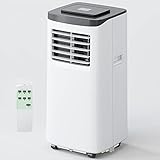
Portable air conditioners have long been the go-to solution for millions, offering flexible, powerful cooling without permanent installation. Yet, they carry an inherent flaw—the entire machine, compressor and all, lives inside your room. The noise is not a distant murmur from outside a window; it’s a constant presence. So, when a product like the FIOGOHUMI 10000BTU arrives with a whisper of a promise—a noise level as low as 45 decibels—it’s natural to be both hopeful and skeptical. But what does that number truly mean when the machine is humming in the corner of your bedroom at 2 a.m.? This isn’t just a review; it’s a deep dive into the sound of comfort, using this air conditioner as our case study to explore how you can choose a genuinely quieter companion for your summer.

The 45dB Promise: Deconstructing the Quietest Claims
Before we get seduced by a single number, let’s establish a crucial ground rule: there is no such thing as a silent portable air conditioner. The laws of physics dictate that compressing refrigerant and moving large volumes of air will generate noise. A typical portable AC unit operates somewhere between 50 and 55 decibels during normal cooling, a sound level comparable to a lively conversation. It’s noticeable, and for many, it’s disruptive.
This context is what makes FIOGOHUMI’s claim of ≤45dB so compelling. However, another data point from a different technical review places it at ≤53dB. This isn’t necessarily a contradiction; it’s a story told in different chapters. The 45dB figure is likely achieved under specific, ideal conditions—almost certainly on the lowest fan setting in its dedicated “Sleep Mode.” The 53dB figure, on the other hand, likely represents the sound of the unit doing its primary job on a standard cooling setting.
To truly understand these numbers, let’s place them in the real world:
| Sound Level (Decibels) | Comparable To… | Subjective Experience |
|---|---|---|
| 45 dB | A quiet library, the hum of a modern refrigerator | A gentle, low background noise. Barely noticeable for most. |
| 53 dB | A quiet office, a soft conversation | Clearly audible, but not overwhelming. A steady hum. |
| 60 dB | A normal conversation, a busy restaurant | Difficult to ignore; you might raise your voice to speak over it. |
The key takeaway is to shift your goal from finding a “silent” unit to understanding the “levels of quiet” a unit offers. The FIOGOHUMI’s promise isn’t one of absolute silence, but one of versatility—the potential for a deeper quiet when you need it most, like during sleep, while still performing effectively at a more standard, audible level during the day.

Anatomy of Noise: What’s Making the Hum Inside the Box?
To appreciate the efforts made to quiet a machine, you first need to understand where its voice comes from. In any portable air conditioner, the soundscape is dominated by two primary sources. First is the compressor, the heart of the cooling system. It’s responsible for the low-frequency, resonant hum you feel as much as you hear. It cycles on and off to maintain temperature, and its startup can be the most jarring sound. Second is the fan, which is responsible for pulling in warm air and pushing out cool air. This creates a constant, higher-frequency “whoosh” sound. The faster the fan spins, the louder this sound becomes.
Unlike split-system air conditioners that place the noisy compressor unit outdoors, a portable AC packs everything into a single indoor chassis. It’s an engineering marvel of compactness, but an acoustic challenge. The sound has nowhere to go but into your living space. Therefore, any meaningful reduction in noise must tackle these two sources directly.
Engineering for Silence: A Look Inside the FIOGOHUMI 10000BTU
While constrained by the portable form factor, thoughtful engineering can make a significant difference. Using the FIOGOHUMI as our specimen, we can see a multi-pronged approach to noise reduction. The manufacturer highlights an “efficient and powerful rotary compressor.” This is more than marketing jargon. Rotary compressors are generally smoother and have fewer vibrations than older reciprocating piston designs, which immediately reduces the foundational, low-frequency hum.
The second line of defense is physical absorption. The mention of “several layers of silencer cottons” points to the use of acoustic dampening materials inside the unit’s casing. These materials act like a sponge for sound waves, trapping them and converting the sound energy into a tiny amount of heat, preventing the noise from escaping the chassis. It’s a straightforward but effective method to muffle the internal workings.
Finally, there’s the intelligent approach. The dedicated Sleep Mode is the most sophisticated tool in the arsenal. It’s not just a “low fan” setting. A well-designed sleep mode, as described in FIOGOHUMI’s features, will intelligently manage the cooling cycle. It will gradually increase the target temperature throughout the night, aligning with your body’s natural drop in metabolism during sleep. This means the compressor needs to cycle on less frequently, and when it does, the fan speed is at its minimum. This is where the ≤45dB promise likely comes to life—by reducing the operation of both major noise sources to their absolute minimum.
Your Sanctuary, Your Silence: How to Create a Quieter Cooling Zone
While manufacturers can engineer a quieter machine, they can’t engineer your room. The final, crucial step in achieving acoustic comfort lies not within the air conditioner’s chassis, but in how you integrate it into your personal sanctuary. The perceived loudness of a unit can vary dramatically based on its environment. Here are actionable strategies to create your own quiet zone.
First, foundation matters. Place the unit on a solid, level floor. Hardwood floors can act like a soundboard, amplifying vibrations. Placing a thick rug or a dedicated anti-vibration mat underneath the air conditioner can absorb these resonant frequencies and make a remarkable difference.
Second, seal the leaks. The window venting kit is a common weak point for sound. Take extra time to ensure the panel is sealed tightly against the window frame. Use the provided foam seals, and consider adding extra weatherstripping to close any gaps. This not only improves cooling efficiency but also blocks external noise and prevents the unit’s sound from echoing back into the room.
Furthermore, think of your room as an audio studio. Hard, flat surfaces like bare walls and windows reflect sound waves, creating a harsher, louder environment. Soft furnishings are your best allies. Curtains, carpets, upholstered furniture, and even a few throw pillows can absorb sound, softening the overall acoustic profile of the room.
Also, keep it clean. A clogged filter forces the fan to work harder, which can increase noise. Cleaning the filter twice a month, as recommended, ensures smooth, quieter airflow.
Finally, adopt a pre-cooling strategy. Don’t wait until you’re about to go to bed to turn on the AC. Run it on a higher, more powerful (and louder) setting for an hour before bedtime to bring the room down to a comfortable temperature. Then, when you’re ready to sleep, you can switch to the ultra-quiet sleep mode, which will then only have to maintain the temperature, not fight to create it.

Conclusion: Redefining “Quiet” for Your Personal Comfort
The quest for a quiet portable air conditioner is not about finding a mythical, silent machine. It’s a journey of understanding, expectation management, and smart application. It’s about learning to decode the numbers, appreciate the engineering, and optimize your own environment.
A unit like the FIOGOHUMI 10000BTU represents a thoughtful attempt to solve the noise dilemma. It doesn’t eliminate it, but it offers a toolkit—a smoother compressor, sound-dampening materials, and an intelligent sleep mode—to manage it effectively. The ultimate choice doesn’t hinge on a single decibel number, but on whether a machine offers a level of quiet that aligns with your personal threshold for peace. By combining a well-designed machine with a well-prepared room, you can finally stop compromising and start enjoying the cool, quiet summer you deserve.