
The Modern Drawbridge: Unlocking the Science Behind Solar-Powered Gate Openers
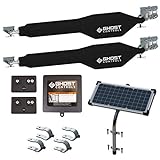
There is a certain ancient magic to a gate that opens at your command. It’s the modern incarnation of a castle drawbridge, a personal threshold between the public world and your private sanctuary. In a downpour, the ability to remain dry in your car while the entrance to your home glides open is a small but profound luxury. This convenience, however, is merely the surface of a deep technological convergence. A system like the Ghost Controls TDS2XP Heavy-Duty Solar Automatic Gate Opener is more than just a motor and a remote; it is a self-sufficient sentinel, a testament to how mechanical engineering, sustainable energy, and robust security protocols can be harnessed by the everyday homeowner.
To truly appreciate this technology, we must look beyond the simple act of the gate swinging open and deconstruct the science that makes it possible. This is not just a product, but a case study in applied physics and intelligent design.

The Muscle: The Engineering of Motion
At the core of any automatic gate opener lies the mechanism that performs the physical labor: the actuator. The Ghost Controls system employs a linear actuator, a device that brilliantly translates the spinning motion of an electric motor into a powerful, straight-line push or pull. Imagine a long, threaded screw housed inside the arm. As the motor turns this screw, a nut travels along its length, extending or retracting the arm with immense force.
This is the source of the “heavy-duty” claim. The engineering of the internal gearing and screw drive allows the system to command gates weighing up to 900 pounds per leaf. It’s a quiet display of mechanical advantage, turning a small motor’s rotation into enough force to move a structure that a person would struggle to budge.
However, this power operates within the firm boundaries of physics. The manufacturer’s warning against using these openers on solid-panel gates is not arbitrary; it is a lesson in aerodynamics. A solid gate acts like a sail in the wind, catching immense force (wind load) that is perpendicular to the opener’s intended direction of movement. This side-loading can exert stress far exceeding the system’s design limits, potentially damaging the motor, the arm, or the gate itself. The design, therefore, is a deliberate balance of power and an acknowledgment of real-world physical constraints.
The Heart: The Science of Off-Grid Power
What truly elevates a modern gate opener is its ability to operate independently of the power grid. This autonomy is achieved through a miniature, self-contained solar power system—a perfect, practical application of off-grid energy principles. This system is a trinity of components: the solar panel, the charge controller, and the battery.
The included 10-watt monocrystalline solar panel is the energy harvester. Through the photovoltaic effect, it converts photons from sunlight directly into a DC electrical current. This current doesn’t power the gate directly. Instead, it flows to the system’s heart: a 12-volt deep-cycle marine-type battery (which users must provide separately).
This choice of battery is critical. Unlike a car’s starter battery, which is designed to deliver a massive jolt of energy for a few seconds (a sprinter), a deep-cycle battery is a marathon runner. It’s engineered to provide a steady stream of power over a long period and to withstand being deeply discharged and recharged hundreds of times. This is the exact cycle a solar-powered system endures: slowly charging during the day, powering the gate on demand, and surviving periods of low light.
The crucial, often-overlooked question is: is 10 watts enough? The answer lies in the concept of an “energy budget.” The “income” is the energy generated by the panel, which is dependent on your geographic location’s “peak sun hours.” The “expenses” are the system’s standby power consumption plus the energy consumed by each open/close cycle. For a user in sunny Arizona cycling their gate twice a day, 10 watts may be ample. For someone in cloudy Seattle using it ten times a day, the energy budget might run a deficit, explaining why the system is wisely designed to be expandable to 30 watts of solar input. Understanding this balance is key to ensuring year-round reliability.

The Shield: A Trinity of Security
A gate’s purpose is security, and a modern opener must provide it on multiple fronts: operational, digital, and physical.
First is operational safety. An automated gate moving with 900 pounds of force is a potential hazard. This is where the UL325 safety standard comes in—a set of rigorous requirements for all gate operators. The Ghost Controls system’s “SafeForce Technology” is an elegant engineering solution to meet these standards. It acts as an inherent form of entrapment protection by constantly monitoring the motor’s electrical current. If the gate encounters an obstruction—a child, a pet, or a vehicle—the motor has to work harder, causing a spike in the current. The control board instantly detects this anomaly and commands the motor to stop or reverse, preventing injury.
Second is digital security. In an era of wireless everything, the signal from your remote is a digital key. Early systems used a fixed code; pressing the button sent the same signal every time. This made them vulnerable to a “replay attack,” where a hacker could record your signal and play it back later to open your gate. “GhostCode” technology is the antidote, employing a rolling code system. Each time you press the remote, it sends a new, unpredictable code from a pool of millions of possibilities, synchronized with the receiver. The gate will only respond to the next code in the sequence. Any captured code is useless the moment it’s been used, much like a bank’s single-use security token.
Finally, for ultimate peace of mind, this digital shield can be backed by physical reinforcement. Optional add-ons like an automatic gate lock (the “ZombieLock”) provide a heavy-duty physical latch, ensuring the gate cannot be forced open even if the operator arms are compromised.
The Brain: Connectivity and Intelligence
The final piece of the puzzle is the system’s brain—the control board—and its ability to connect to our increasingly smart world. While robust in its basic function, the system can be upgraded with a “Multi Connect” module. This accessory is the bridge that connects the isolated, off-grid gate to the Internet of Things (IoT).
With this addition, the gate’s control extends from a 1,000-foot remote range to anywhere in the world with an internet connection. A smartphone app becomes a universal remote, allowing you to grant access to a delivery driver from your office or check the gate’s status (open or closed) while on vacation. More importantly, this connectivity offers diagnostic capabilities. It can report the battery’s voltage, giving you real-world data on the health of your energy budget. This transforms system maintenance from reactive (fixing it when it breaks) to proactive (adding another solar panel when you see the voltage consistently dropping during winter).
In conclusion, the modern solar gate opener is a microcosm of brilliant, accessible technology. It demonstrates how the raw power of mechanical leverage, the silent efficiency of solar energy, and the invisible fortress of digital encryption can converge into a single, reliable system. It stands as a powerful symbol of the modern DIY spirit—that with thoughtful engineering and a clear understanding of the underlying science, the power to build a more secure, convenient, and self-sufficient home is truly in our own hands.