
The Intelligence of Air: Sensors, Connectivity, and Maintenance
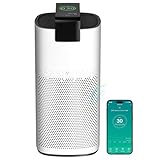
In the past, air purifiers were binary devices: On or Off. The user had to guess the air quality and manually adjust the speed. Today, devices like the MORENTO MR7566-WF have evolved into autonomous environmental robots. They sense, they calculate, and they communicate.
This intelligence is built on the foundation of Sensor Technology and IoT (Internet of Things) connectivity. But how does a machine “see” invisible particles? And what is the economic value of a smart maintenance schedule? This article explores the physics of PM2.5 detection, the logic of automated control loops, and the science of filter longevity.
The Eye of the Machine: Laser Scattering Physics
The defining feature of a smart purifier is its PM2.5 Sensor. The MR7566-WF uses a Laser Scattering (or Optical) sensor to detect particulate matter.
* The Mechanism: A small internal fan draws a sample of room air into a dark chamber. A laser diode shoots a focused beam of light through this air stream.
* The Physics: When the light hits a particle (dust, smoke), it scatters. A photodetector measures the intensity and angle of this scattered light.
* The Calculation: Based on Mie Scattering Theory, the device’s microprocessor calculates the size and concentration of the particles. It distinguishes between PM2.5 (fine respirable particles) and larger dust.
This data is visualized instantly on the device’s display (Green/Yellow/Red) and the App. This Real-Time Feedback Loop transforms the user’s relationship with their environment. You are no longer guessing if the air is dirty; you have quantitative proof. It makes the invisible visible, validating the machine’s operation.

The Logic of Automation: Auto Mode and Efficiency
The sensor data feeds directly into the Auto Mode algorithm. This is a classic Proportional Control System.
* Input: PM2.5 concentration (µg/m³).
* Logic: If PM2.5 > Threshold A, Fan Speed = High. If PM2.5 < Threshold B, Fan Speed = Low/Sleep.
* Output: Optimized fan speed.
This automation has profound implications for Energy Efficiency and Acoustic Comfort. The machine only runs at high power (and high noise) when necessary. When the air is clean, it throttles down to a whisper. For the user, this means the device is unobtrusive but reactive. It responds to a burnt toast incident in the kitchen before the user even smells it, ramping up to scrub the air, then settling back down once the crisis is averted.
The Connected Home: WiFi and App Ecosystem
The integration of WiFi and the “Havaworks” App extends the control loop beyond the chassis of the machine.
* Remote Monitoring: You can check your home’s air quality from the office. If you see a spike (maybe a window was left open), you can remotely activate high speed to clean the air before you arrive home.
* Scheduling: The app allows for temporal programming. You can set the purifier to “Sleep Mode” automatically at 10 PM and “High Mode” at 8 AM for a morning clean-up. This aligns the machine’s operation with the biological rhythms of the household.
* Voice Control: Integration with Alexa/Google Home adds a layer of accessibility. “Alexa, turn on the air purifier” is a convenience that integrates air quality into the smart home command structure.

Maintenance Science: The Economics of Filter Life
The Achilles’ heel of any air purifier is the filter. It is a consumable. The MR7566-WF’s app tracks filter life.
* Algorithm-Based Tracking: Unlike simple timers, smart purifiers often estimate filter life based on fan speed and run time. Running on High degrades the filter faster than Sleep Mode.
* The Cost of Neglect: A clogged HEPA filter increases pressure drop (\Delta P). The fan must work harder (consuming more watts) to move less air. The CADR plummets. Worse, a saturated carbon filter can desorb odors back into the room.
* Dual Filter Economics: The machine requires two filters (one for each side). While this increases the replacement cost per event, the doubled surface area means the filters load more slowly per square inch. The Dirt Holding Capacity is higher, potentially leading to longer intervals between changes compared to single-filter units of similar airflow.
Conclusion: The Data-Driven Sanctuary
The MORENTO MR7566-WF is a machine of the data age. It combines the brute force of dual-intake aerodynamics with the finesse of laser sensing and cloud connectivity.
By quantifying the air quality and automating the response, it relieves the user of the cognitive load of managing their environment. It turns air purification into a background service—reliable, invisible, and intelligent. For the modern homeowner, it offers not just clean air, but the peace of mind that comes from knowing exactly how clean it is.